Architecting a Cloud-Native Race Management Platform on AWS for VUT
HomePortfoliosArchitecting a Cloud-Native Race Management Platform on AWS for VUT
Overview
VUT partnered with TitanBases to modernize its race management platform on AWS. Through hands-on AWS consulting and cloud-native architecture design, TitanBases helped VUT build a resilient, scalable platform that improves system performance, operational reliability, and day-to-day confidence in running critical race operations.
Challenges
VUT needed a scalable and reliable infrastructure to operate their nationwide trail-running events. Their existing setup lacked high availability, automated deployment processes, and standardized security practices. VUT sought guidance to adopt an AWS architecture capable of supporting peak traffic during race operations.
Project Name
Architecting a Cloud-Native Race Management Platform on AWS for VUT
Client
Vietnam Unlimited Discovery Joint Stock Company
Our Role
Business Application
Share
Tags
How We Work
From the designers and engineers who are creating the next generation of web and mobile experiences, to anyone putting a website together for the first time. We provide elegant solutions that set new standards for online publishing.
AWS Architecture Consulting & Best Practices TitanBases provided hands-on AWS architecture consulting, guiding VUT on cloud-native design principles and AWS best practices to support mission-critical race operations.
Cloud-Native Platform Design We designed an AWS-native architecture centered on Amazon EKS within a secure VPC, leveraging multi-AZ subnets, managed NAT Gateway, and Elastic Load Balancing to ensure high availability and resilience.
Data & Storage Architecture Amazon RDS was used for relational workloads, while Amazon S3 and Glacier supported scalable and cost-efficient object storage. Amazon EFS enables shared file access across containerized workloads.
CI/CD & Automation Enablement TitanBases guided VUT’s team in implementing CI/CD pipelines using AWS CodePipeline, CodeBuild, Amazon ECR, and EventBridge to automate build, deployment, and operational workflows.
Operational Readiness & Reliability The resulting architecture enables dynamic scalability, improved operational visibility, and higher reliability—especially during peak race-day traffic and time-sensitive workloads.
Cost Optimization & TCO Guidance
TCO included cost comparisons between managed Kubernetes on Amazon EKS and self-managed clusters, ensuring the right balance between operational effort and long-term cost efficiency.
We optimized network costs through efficient NAT Gateway usage and applied storage lifecycle policies to transition data to Amazon S3 Glacier.
Right-sizing recommendations for compute resources helped reduce unnecessary spend while maintaining performance for race-day workload
Results
VUT successfully adopted a standardized, highly available AWS architecture for race operations. System reliability improved through multi-AZ design, while deployment time decreased with CI/CD adoption. VUT gained better operational observability and reduced risks associated with peak-time traffic during major events.
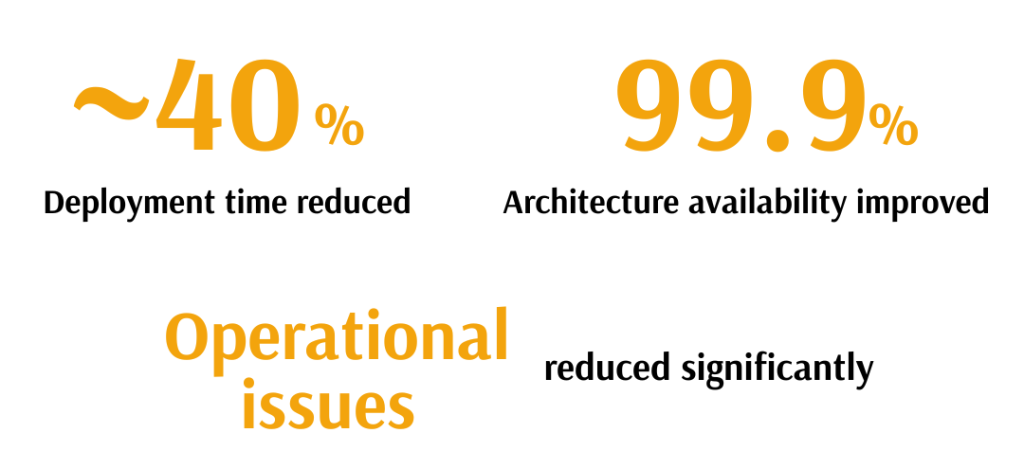
Deployment time reduced by ~40%
Architecture availability improved to 99.9%
Operational issues during events reduced significantly
Key Takeaways
Early requirement clarification and performance expectation mapping greatly improved architecture decision-making. Defining security, networking, and CI/CD standards upfront accelerated the consulting process and reduced later adjustments