Ingestion and retrieval
Review how knowledge enters the system, moves through its lifecycle, and is retrieved for grounded responses.
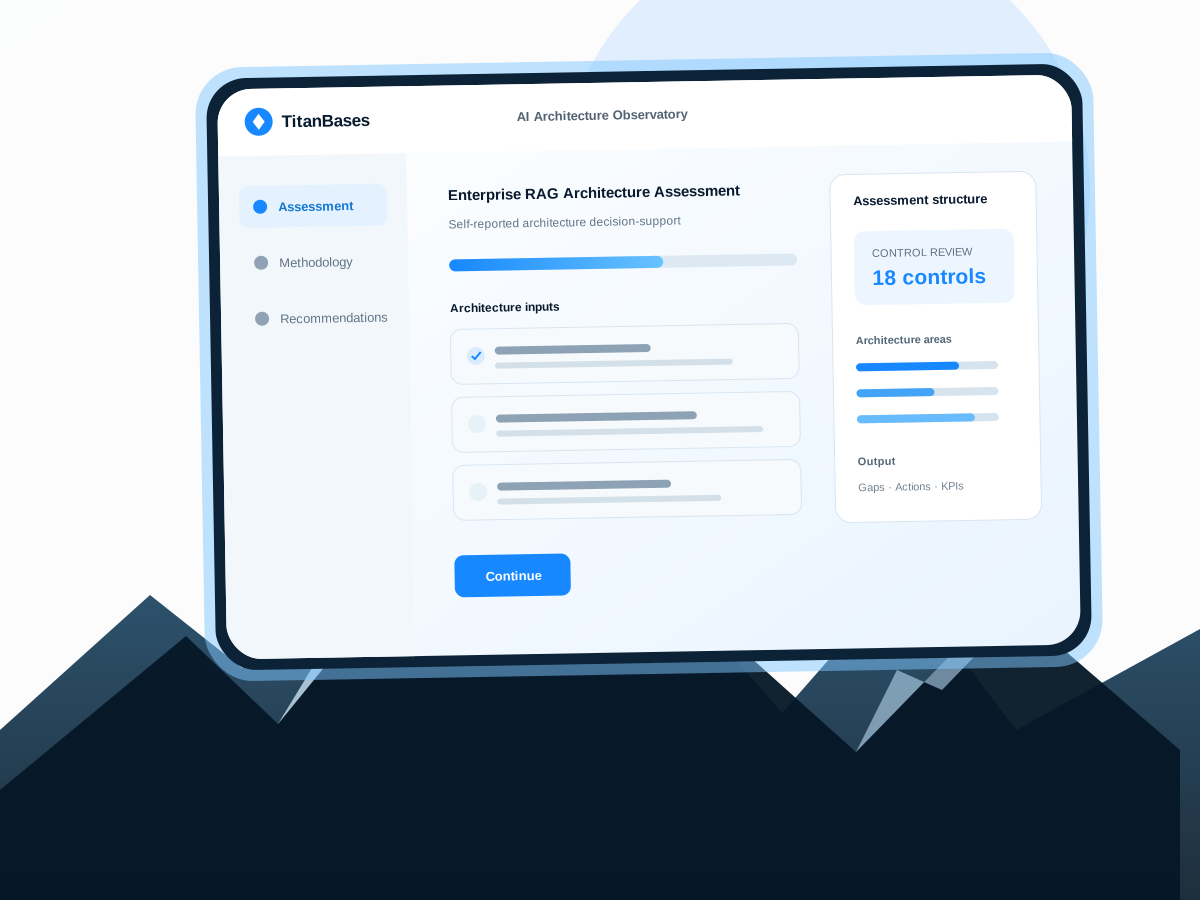
Enterprise RAG Architecture Assessment
Assess your RAG workload's architecture capabilities, identify critical control gaps, and create a measurable improvement plan — with a downloadable report.
The first Observatory module gives technical leaders a structured, self-reported view of architecture maturity without claiming automated inspection or independent certification.
What it is
AI Architecture Observatory is a TitanBases platform for structured architecture decision-support. It helps teams examine capability, control, and improvement questions around important AI workloads.
Its first module focuses on Enterprise RAG Architecture Assessment: a guided review of the practices that shape ingestion, retrieval, evaluation, governance, security, reliability, and operations.
Why enterprise RAG architecture matters
A successful RAG response is only one signal. Sustainable systems also need intentional controls across the workload lifecycle.
Review how knowledge enters the system, moves through its lifecycle, and is retrieved for grounded responses.
Make evaluation signals, quality controls, and improvement priorities visible to technical decision-makers.
Surface architecture controls that support appropriate access, evidence handling, and accountable operation.
Connect reliability, observability, and operational practices to a practical architecture improvement plan.
How the assessment works
The flow keeps architecture context, control review, findings, and next actions connected.
Provide self-reported context about the RAG workload, architecture decisions, and current practices.
Work through the technical controls and critical gates that shape the assessment.
See how the reported practices map to maturity areas and where critical gaps need attention.
Turn findings into prioritized recommendations, practical KPIs, and a downloadable report where supported.
Who it is for
Use the assessment when planning a RAG PoC, moving from PoC to production, or improving an existing production architecture.
Evaluate the architecture behind a RAG proof of concept or an operating workload.
Structure architecture conversations around shared controls, gaps, and evidence.
Align teams on priorities as a RAG initiative moves toward production.
Connect technical findings to governance, risk, and measurable improvement decisions.
Identify the operating capabilities that need focused investment and ownership.
Review enterprise architecture implications without treating the output as a certification.
Assessment deliverables
The assessment organizes the reported architecture state into findings and actions that teams can discuss, assign, and measure.
A structured view of the capabilities reported across the assessment.
Clear visibility into reported control gaps and critical architecture gates.
Recommendations ordered to support a practical improvement sequence.
Suggested measures that help teams track progress after the assessment.
A report designed to support internal review and follow-up where download is supported.
Capability view
Methodology and limitations
The assessment reflects the workload information and practices supplied by the participant. TitanBases AI Architecture Observatory does not independently verify those inputs.
The output is not an automated infrastructure inspection, security audit, compliance attestation, or guarantee of production readiness.
Recommendations should be reviewed with the workload's business requirements, risk profile, constraints, and supporting technical evidence.
FAQ
Clear boundaries make the assessment more useful.
No. The assessment is based on information you report about one RAG workload. It does not connect to, scan, or independently inspect your infrastructure.
No. It is architecture decision-support. The output is not an independent security audit, certification, compliance attestation, or production-readiness guarantee.
V1 focuses on Enterprise RAG Architecture Assessment across 18 technical controls, critical gates, maturity mapping, gaps, prioritized recommendations, and measurable KPIs.
Yes. It is intended for RAG proof-of-concept planning, PoC-to-production decisions, and the improvement of an existing production architecture.
No. Results reflect the supplied answers and the assessment methodology. Self-reported evidence is not independently verified by the platform.
No. This page explains the product. The assessment itself runs separately at observatory.titanbases.com.
Start with one workload
Build a clearer view of capabilities, critical gaps, and the actions that can move the architecture forward.