Published Oct 7, 2026
The Rise of the AI Architect: 9 Skills Enterprises Need in the Multi-Model Era
Enterprise AI is creating a new architecture discipline. Explore nine AI Architect capabilities across models, RAG, agents, governance, evaluation, cloud platforms and AI economics.
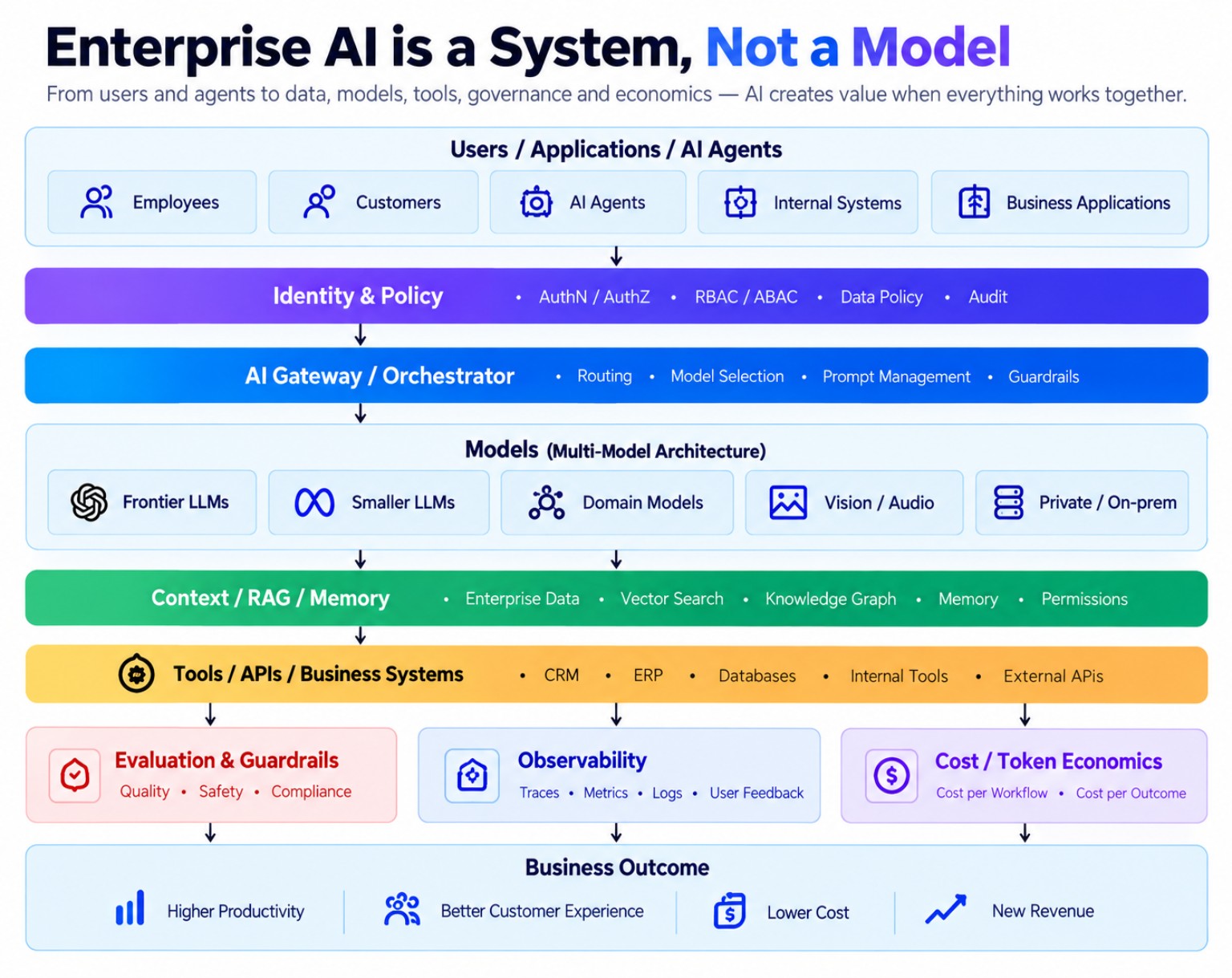
Enterprise AI is no longer a single-model selection exercise. As organizations move from isolated copilots to production systems, they must design the interfaces between users, agents, data, models, tools, governance and economics. That is why a new architecture discipline is emerging: the AI Architect. The role is not about choosing the most impressive model in a benchmark. It is about matching intelligence, controls and cost to a measurable business outcome. In this article, we map the nine capabilities enterprise teams need to make that discipline practical.
The AI Architect skill stack: nine capabilities
1. Business problem framing
Start with the decision or workflow that must improve. Define the user, the moment of value, the acceptable failure mode and the metric that will prove progress. A bounded use case makes later choices about data, models and human approval testable.
2. Model selection and multi-model architecture
Different workloads need different levels of intelligence, latency and cost. Route classification, summarization, document analysis and agentic tasks to fit-for-purpose models, and keep a fallback path when a provider or model is unavailable. Production API patterns matter as much as model quality.
3. Context, RAG and AI-ready data architecture
Retrieval quality is an architecture concern, not a prompt trick. Design chunking, metadata, access control, freshness, vector search and evaluation together so the model receives the right context. MongoDB Atlas Vector Search can be one part of a data plane that preserves operational context and permissions.
4. Agent and tool architecture
Agents need bounded tools, explicit permissions and clear hand-off rules. Define what an agent may read, write or trigger; isolate risky actions; and record the full tool trace. An agent runtime should be treated as a governed system, not an opaque chat feature.
5. Evaluation, observability and reliability
Production quality requires repeatable evaluation sets, traces, latency budgets, error taxonomies and feedback loops. Measure retrieval, tool use and business outcomes separately so a change in one layer does not hide a regression in another.
6. AI security and governance
Identity, authorization, data policy, secrets, audit and human approval belong in the architecture from day one. Threat models should include prompt injection, data leakage and excessive agency, with controls that are enforceable at runtime.
7. AI economics and FinOps
Track token consumption, usage attribution, workflow cost and cost per outcome. A cheaper model is not automatically cheaper if it creates more retries, human review or downstream work. Economics should be visible by product, team and workflow.
8. Cloud and platform architecture
The platform must provide resilient networking, observability, deployment automation, secrets management and recovery paths. AWS is often the foundation for these controls, but the design should remain portable at the interface boundaries.
9. Human AI operating model
Adoption is a system capability. Define who owns prompts, evaluations, incidents, policy exceptions and model changes. Give operators a clear escalation path and give users feedback loops that improve the product without bypassing governance.
TitanBases’ engineering view: connect the layers, not the logos
The most durable enterprise AI systems connect cloud foundation, operational data and model capability through explicit interfaces. AWS can provide the platform and resilience layer; MongoDB can provide operational context, search and memory; OpenAI can provide frontier intelligence and agent capabilities. The architect’s job is to make these layers observable, secure and replaceable where appropriate. Explore our AWS, MongoDB and OpenAI partner practices before choosing a stack.
A practical starting point for enterprises
Start with a bounded production experiment rather than a broad transformation program. The following checklist keeps the first architecture decision measurable and reversible:
- Bound the use case and name the user, workflow and business decision.
- Define one success metric and one unacceptable failure mode.
- Set the identity, data and tool boundary before choosing a model.
- Choose a routing and fallback strategy for quality, latency and cost.
- Create an evaluation set that reflects real traffic and edge cases.
- Attribute usage and cost by product, team and workflow.
- Assign an owner for incidents, policy exceptions and model changes.
Conclusion
The AI Architect is emerging because enterprise AI is no longer a single-model purchase. It is a system of users, agents, data, models, tools, controls and economics. Teams that can design those interfaces will move from impressive demos to reliable business outcomes. If you are shaping that journey, talk to TitanBases about an enterprise AI architecture and PoC plan: /contact.