Published Oct 8, 2026 · Updated Oct 8, 2026
AWS PoC Cost and Timeline: What to Budget, How Long It Takes, and What Affects Both
A practical guide to the cost drivers, timeline dependencies, planning decisions and partner role behind an AWS proof of concept—without treating cloud consumption as the whole budget.
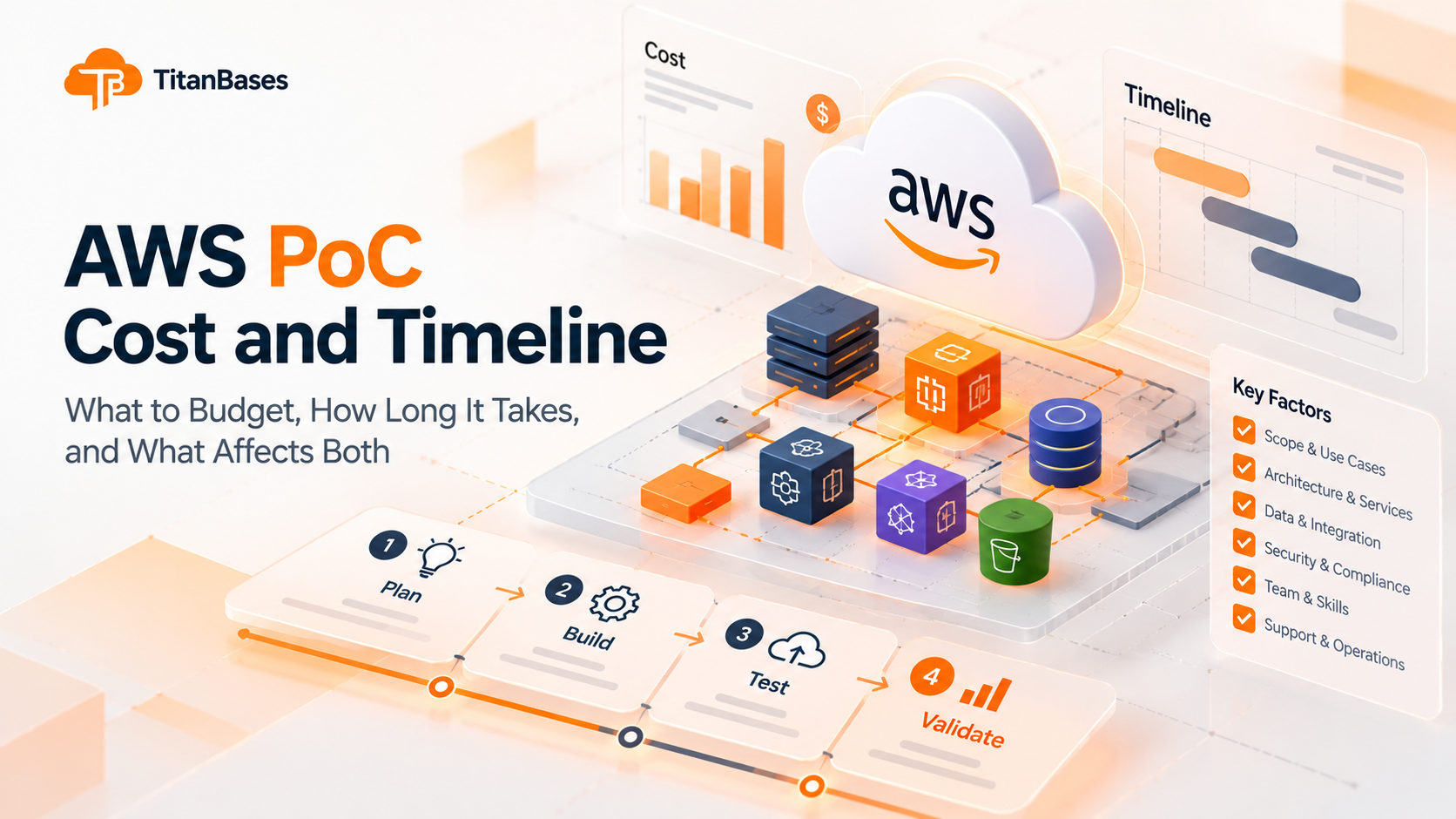
There is no universal fixed cost or fixed timeline for an AWS proof of concept (PoC). Both are driven by the question being tested, the workload scope, integration and security requirements, data readiness, the people needed to validate results, and the clarity of the success criteria. The AWS bill is only one part of the total PoC cost. A useful PoC starts with a specific assumption and ends with an evidence-based decision: move to production, iterate, or stop.
What an AWS PoC includes: a planning lifecycle
A PoC is not simply a temporary AWS environment. It is a bounded decision process. A practical lifecycle is: discovery and scoping; architecture; environment setup; implementation; validation; results review; and a production decision. Each phase should produce an explicit output, identify accountable participants, and surface dependencies early. For the broader definition of an AWS PoC and the implementation lifecycle, see TitanBases’ existing AWS PoC guide.
What affects an AWS PoC timeline?
Timeline is usually determined by dependencies rather than by provisioning alone. A narrow greenfield test with a clear owner can move quickly. A PoC involving a legacy estate, regulated data, IAM or network approvals, several teams, third-party systems, or production-like controls needs more coordination. Unclear acceptance criteria are a common reason a PoC stays open longer than intended.
Timeline drivers to clarify before work starts
Clarify the workload and hypothesis; greenfield versus legacy integration; data availability and quality; IAM, network and security approvals; third-party interfaces; named customer-side owners; test environment readiness; and the date by which a decision is needed. A PoC that tries to become a miniature production system can lose the speed and learning benefits of a PoC.
What determines AWS PoC cost?
AWS infrastructure consumption is one cost driver: compute, storage, database services, networking and data transfer, AI or ML services where relevant, and logging or observability. Usage should be estimated from the intended test architecture rather than from a generic package.
Engineering effort is another driver: architecture, provisioning, infrastructure as code, integration, implementation, testing and validation. Customer-side effort also matters—subject-matter experts, access to data, security review and internal approvals can determine elapsed time and total effort. Licences, external APIs and SaaS tooling may add third-party costs. Infrastructure cost alone is therefore not the same as total PoC cost.
PoC scope patterns and the cost–timeline trade-off
A narrow validation PoC tests one technical assumption or component. An integrated PoC combines several AWS services with one or more real integrations. A production-like PoC adds more security, networking, observability, integration and operating requirements. As scope expands, engineering effort and coordination tend to rise; cloud consumption may rise as well; and elapsed time commonly increases. These are planning patterns, not TitanBases pricing packages.
Tighter scope can shorten elapsed time. Parallel engineering can reduce elapsed time but can require more effort. Reusable infrastructure-as-code and reference architectures can reduce repeated setup work. The cheapest PoC is not always the one with the smallest AWS bill: poor scoping can consume little infrastructure while wasting significant engineering time.
How an AWS Partner can help with PoC and project delivery
Partner level and capability can be useful buyer signals, but neither is a guarantee of a project outcome and AWS does not state that only Advanced Tier Partners can support every PoC. Buyers should verify the partner’s relevant architecture experience, delivery scope, security and operational approach, customer evidence, and the AWS program requirements that apply to the specific engagement. TitanBases is an AWS Advanced Tier Services Partner.
A capable partner can help turn an uncertain idea into a testable plan: assess the workload, define business and technical success criteria, design the architecture, identify dependencies, implement the PoC, validate outcomes and prepare a production transition plan. For a buyer-oriented explanation of what to assess, see the TitanBases guide to choosing an AWS Partner.
AWS programs: navigation, not a promise
AWS states that partner funding benefits and programs depend on a partner’s journey and participation in relevant programs, and that specific fund requests go through review and validation. A partner can help review the workload and opportunity, identify potentially relevant programs, and help navigate the applicable engagement or application process. Eligibility, geography, program conditions and AWS approval remain program-specific; TitanBases cannot approve AWS programs or guarantee credits or funding. For program and credit detail, see the existing AWS Credits and Funding guide.
AWS PoC planning checklist
Before starting, document: the problem statement; business and technical objectives; the workload boundary; measurable success criteria; decision owners and stakeholders; AWS services under consideration; the current architecture; integration dependencies; data readiness and test data; IAM, security and network prerequisites; expected outputs; decision deadline; and the production next step if the hypothesis is validated.
When should an AWS PoC end?
Proceed to production when the agreed success criteria are achieved and the remaining production work is understood. Iterate when the result is promising but the architecture, scope or operating assumptions need adjustment. Stop when a core technical or economic assumption is not validated. Stopping is not a failure: the purpose of a PoC is to reduce uncertainty before a larger investment.
Plan your AWS PoC with TitanBases