AI for Financial Services in Vietnam: TitanBases Visits FintechAI and AWS in Ho Chi Minh City
A working visit to FintechAI in Ho Chi Minh City gave TitanBases a closer view of how AI initiatives in Vietnam's financial-services sector are evolving from individual use cases toward production-ready systems, data platforms, infrastructure, and enterprise integration.
Published Sep 25, 2026
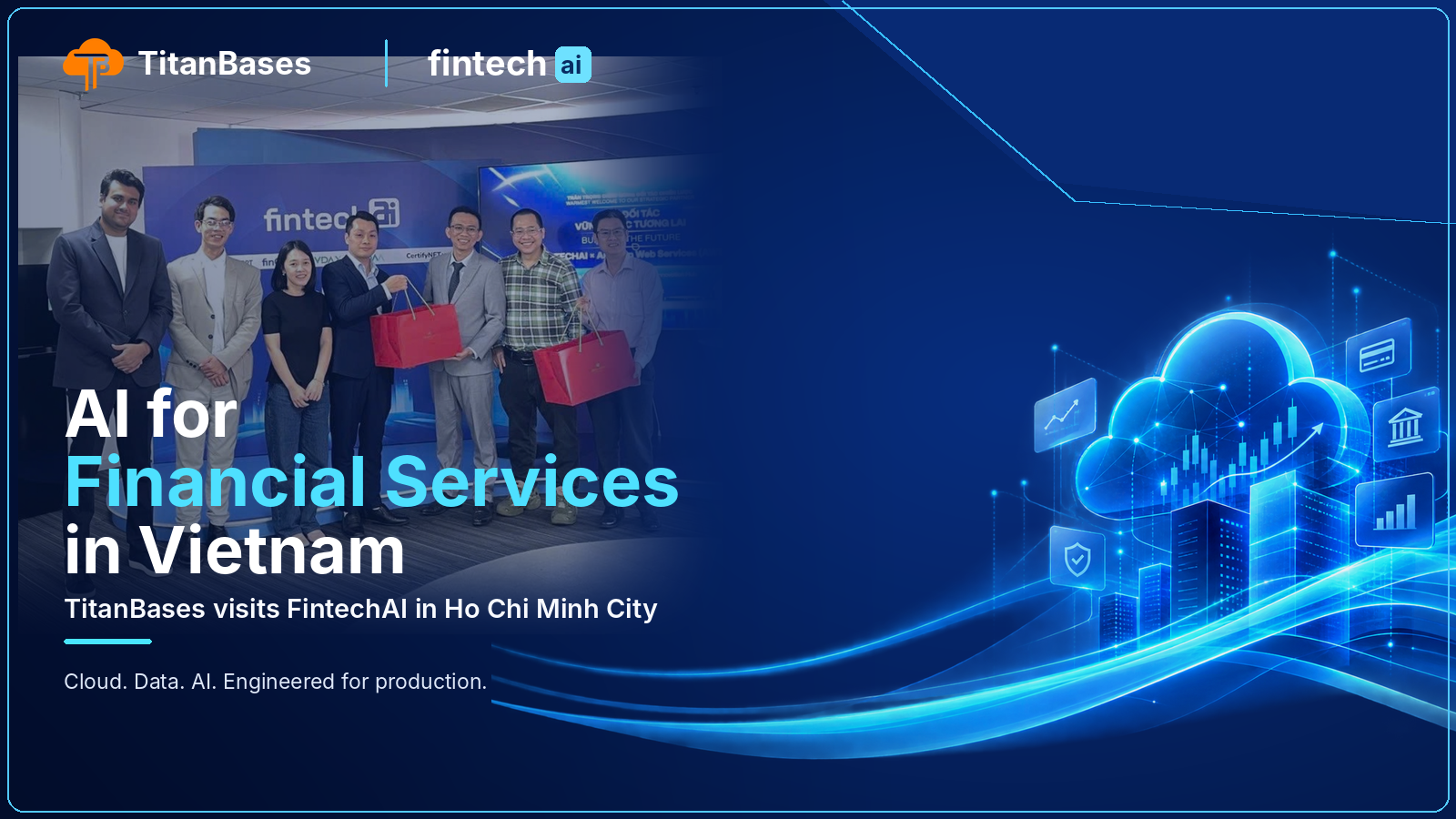
Artificial intelligence in financial services is moving beyond isolated experiments. As banks, fintech companies, and financial institutions explore more advanced AI capabilities, the challenge increasingly extends beyond selecting a model. Production deployment requires applications, enterprise data, cloud infrastructure, security, integration, operational controls, and engineering teams to work together as one system. That was one of the key themes emerging from a recent TitanBases working visit to FintechAI in Ho Chi Minh City, together with representatives from Amazon Web Services (AWS). Representing TitanBases during the visit were Nguyễn Việt Dũng, Deputy CEO, and Nguyễn Tuấn Long, Sales Director. The session provided an opportunity to exchange perspectives on FintechAI's development roadmap, the evolution of its technology platforms, and the requirements surrounding future AI and system initiatives for the financial-services industry. The purpose of the discussion was not simply to look at individual AI models or isolated applications. It was to examine the broader engineering environment required to move financial-services AI from ideas and prototypes toward systems capable of operating reliably in production.
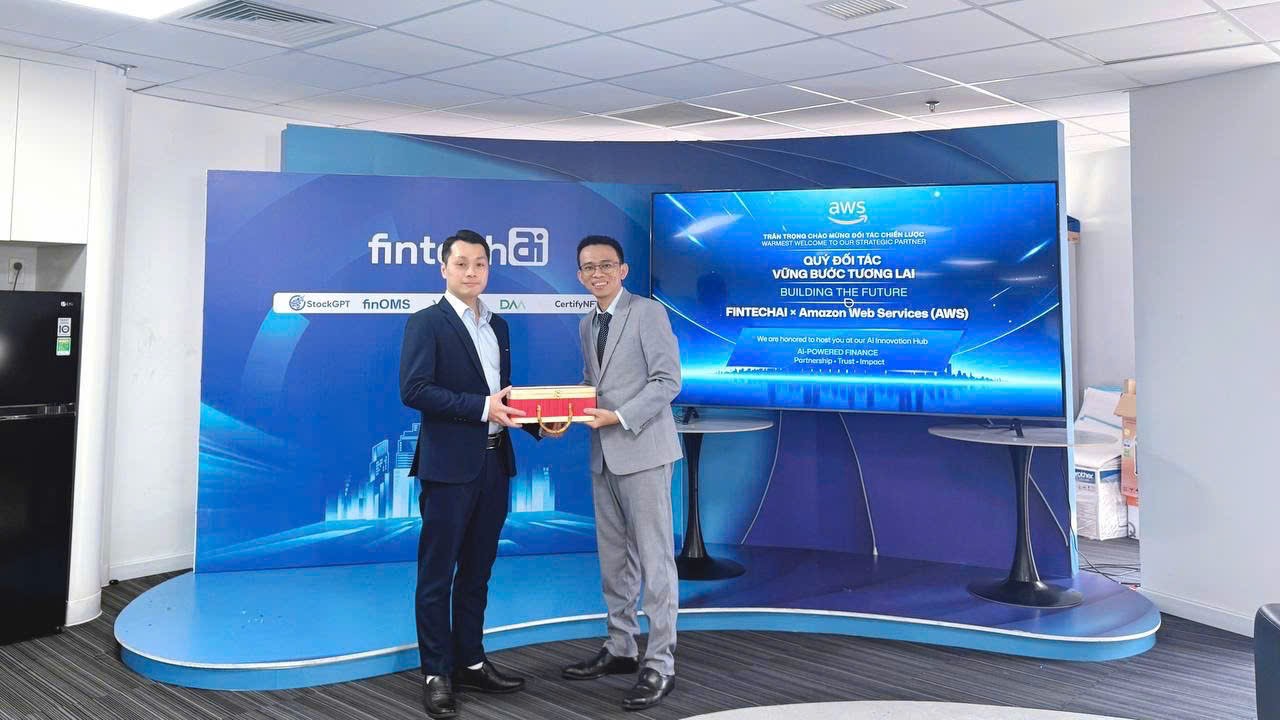
From AI Use Cases to Production Systems
The financial-services sector has been one of the most active environments for enterprise technology adoption. AI introduces another layer of capability, but it also increases the importance of the systems around it. A useful AI application may begin with a model, but production operation typically involves a much wider architecture:
- enterprise applications and user workflows;
- access to operational and analytical data;
- model and AI-service integration;
- APIs and system interfaces;
- identity and access controls;
- security and regulatory requirements;
- scalable compute and cloud infrastructure;
- observability and operational monitoring;
- availability and resilience;
- governance over data and AI usage.
This changes how organizations need to think about AI transformation. The question is no longer only: “Which AI model should we use?” Increasingly, the more important question is: “How do we engineer the complete system around AI so that it can operate securely, reliably, and at enterprise scale?” For financial institutions, this distinction is particularly important. A proof of concept may demonstrate that an AI capability works. A production system must continue working when connected to real users, real business processes, enterprise data, security policies, infrastructure dependencies, and operational requirements.
What We Heard from FintechAI
During the working session, FintechAI's leadership shared additional context around its development roadmap and upcoming technology initiatives serving the financial-services sector. The discussion reinforced a direction that TitanBases is increasingly seeing across enterprise AI projects: organizations are moving from experimentation toward more integrated AI systems. That evolution creates requirements across several layers at the same time. An AI capability may need access to existing enterprise data while remaining compatible with current business systems. It may need to integrate with applications already used by customers or internal teams. Infrastructure needs to support both unpredictable AI workloads and conventional application services. Security, monitoring, governance, and operational resilience must also be considered from the beginning rather than added after deployment. For technology organizations serving banks and financial institutions, these requirements make AI transformation as much an engineering and architecture challenge as an AI-model challenge. The detailed customer roadmap and individual projects discussed during the meeting remain confidential. However, the broader direction is clear: financial-services organizations are increasingly considering AI as part of a larger production technology stack rather than as an isolated feature.
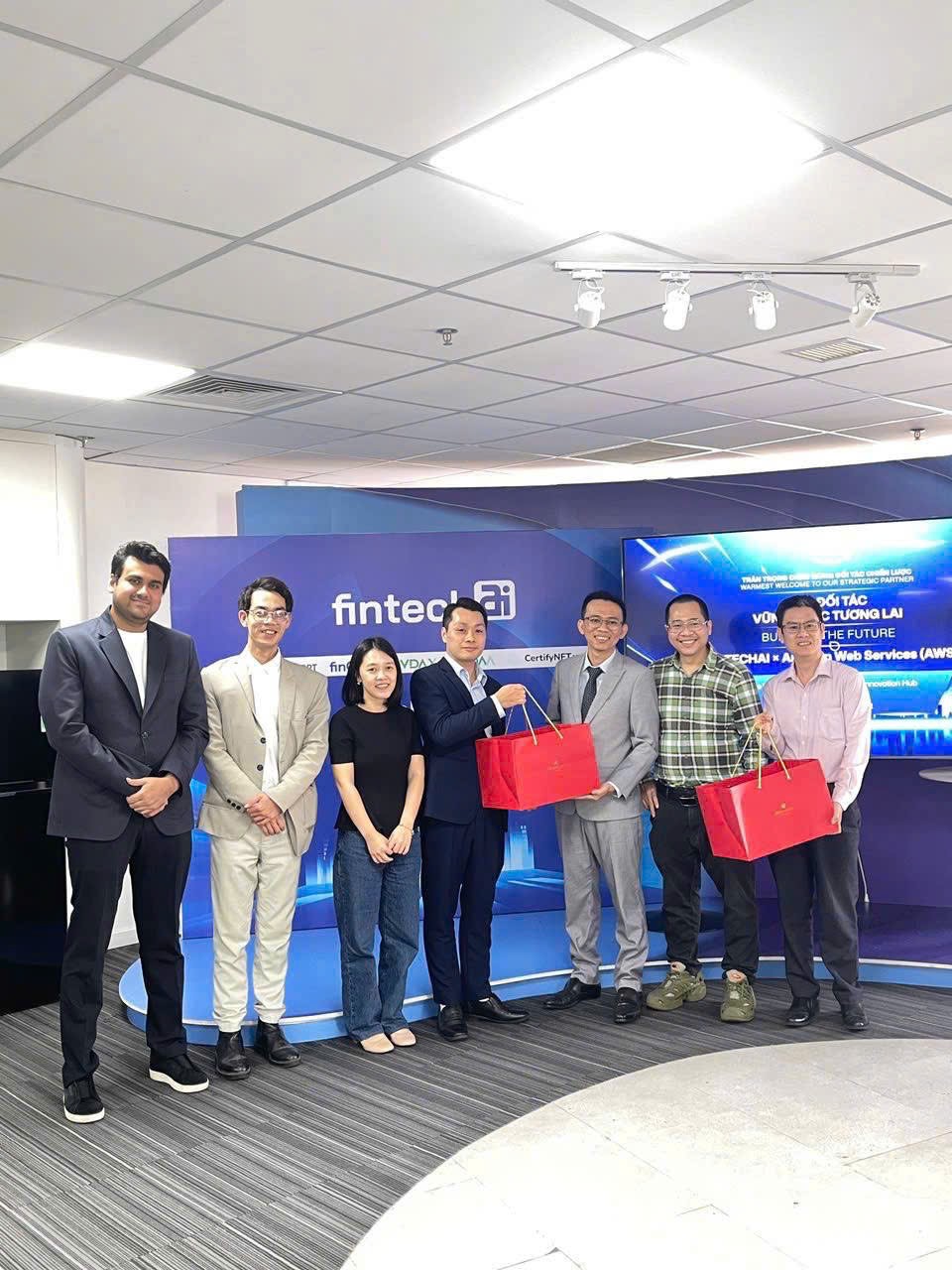
The Infrastructure Behind Production AI
Enterprise AI systems rarely exist in isolation. In practice, a production architecture may connect multiple layers: Business applications → AI capabilities → operational data → cloud infrastructure → security and operations Each layer introduces different technical considerations. At the application layer, AI functionality must fit into real customer or employee workflows. At the AI layer, organizations need to consider model capabilities, inference, orchestration, retrieval, evaluation, and integration. At the data layer, systems need reliable access to operational information while maintaining appropriate controls over how that information is stored, retrieved, and used. At the infrastructure layer, workloads need scalable compute, networking, storage, security controls, monitoring, and operational resilience. Cloud platforms such as AWS provide many of the infrastructure capabilities required to operate these environments, while technology providers and engineering partners still need to determine how those components fit together for a specific business system. For TitanBases, this intersection between Cloud, Data, and AI is increasingly where production AI engineering takes place.
Financial-Services AI Is a Systems Problem
Production AI in financial services is increasingly a systems problem rather than a model-only problem. AI performance alone does not determine whether an enterprise AI project will succeed in production. A technically capable model can still become difficult to deploy if the surrounding system cannot provide reliable data, secure integration, appropriate observability, or predictable operational behavior. For financial-services environments, several questions therefore need to be considered together.
How does AI access enterprise data?
AI applications need the right information at the right time, but access must remain controlled and auditable.
How does AI integrate with existing applications?
Financial institutions rarely build technology environments from zero. New AI capabilities typically have to coexist with established applications, APIs, databases, and operational workflows.
How is the system secured?
Authentication, authorization, network controls, application security, data governance, and operational policies all remain essential regardless of how capable the AI model becomes.
How does the architecture scale?
AI workloads can behave differently from conventional application workloads. Infrastructure therefore needs to accommodate changes in compute requirements, usage patterns, latency, and data access.
How is the system operated after launch?
Production deployment is not the end of the engineering lifecycle. Monitoring, observability, incident response, cost controls, reliability, model evaluation, infrastructure management, and continued application development remain part of normal operations. These considerations are why TitanBases approaches enterprise AI as part of a broader systems architecture rather than as a standalone technology. Once AI becomes part of a production application, organizations must address applications, enterprise data, infrastructure, security, integration, observability, and operational reliability together.
Building AI for Vietnam's Financial-Services Industry
Vietnam's financial-services technology ecosystem continues to develop rapidly. Banks, financial institutions, fintech companies, and technology providers are exploring how AI can improve products, operations, customer interaction, software development, information access, and internal decision-support systems. Not every AI initiative will require the same architecture. Some use cases can be introduced as relatively focused services. Others will depend on significant integration with existing data and applications. As organizations move closer to production, however, infrastructure and engineering disciplines become increasingly important. This is where collaboration between different parts of the technology ecosystem matters. AI providers contribute model capabilities. Cloud platforms provide infrastructure and managed services. Data platforms help applications work with operational information. Application teams connect new capabilities with business workflows. Engineering partners help design, integrate, deploy, and operate the complete system. The result is not a single AI product. It is an AI-enabled production system.
TitanBases: Cloud, Data, and AI Engineered for Production
TitanBases works across the technical layers required to move modern applications from architecture to production. Our work is organized around four core areas:
- Cloud & Infrastructure
- Data Platforms
- AI & Automation
- Platform Engineering
This structure reflects how modern enterprise systems are actually built. AI applications depend on data. Data platforms depend on secure and reliable infrastructure. Applications require engineering and integration. And every production environment needs a platform that can be operated, monitored, secured, and continuously improved. For financial-services organizations, these dependencies become particularly important because reliability, security, integration, and governance cannot be treated as secondary considerations. Our role is therefore not simply to introduce individual technologies. It is to help organizations connect them into systems that can operate in production.
Strengthening the Collaboration with FintechAI
The Ho Chi Minh City visit was also an opportunity to strengthen the working relationship between TitanBases and FintechAI. Understanding a customer's technology roadmap directly helps engineering and commercial teams prepare for what comes next: the infrastructure requirements, data architecture, AI capabilities, integration patterns, and operational constraints that future systems may require. For TitanBases, this type of discussion is an important part of working with customers over the long term. Technology decisions made today influence the systems that organizations will need to operate tomorrow. By maintaining close dialogue with FintechAI and the broader technology ecosystem, TitanBases can better align its cloud, data, AI, and platform-engineering capabilities with the actual requirements emerging from Vietnam's financial-services sector.
Looking Ahead
Enterprise AI is entering a stage where the distinction between an AI project and an IT system is becoming increasingly difficult to make. Once AI becomes part of a production application, the organization must solve many of the same problems that apply to any mission-critical technology platform while also managing the new characteristics introduced by AI. That requires more than models. It requires architecture. It requires data. It requires infrastructure. It requires security. And it requires engineering. Our discussions with FintechAI in Ho Chi Minh City reinforced that direction. As the next generation of financial-services platforms takes shape in Vietnam, TitanBases will continue working with customers and technology partners to turn promising AI capabilities into systems engineered for real-world production. Cloud. Data. AI. Engineered for production.
Frequently Asked Questions
How is AI being used in financial services?
Financial institutions are exploring AI across areas including customer interaction, knowledge access, operational automation, software workflows, analytics, and decision-support systems. Production deployments typically require integration with enterprise applications, data, infrastructure, security controls, and operational processes.
Why is cloud infrastructure important for enterprise AI?
Enterprise AI workloads depend on compute, networking, storage, security, observability, scalability, and access to other application services. Cloud infrastructure can provide these capabilities, but organizations still need appropriate architecture and engineering to integrate them into production systems.
What is TitanBases' approach to AI for financial services?
TitanBases approaches enterprise AI as part of a broader production architecture spanning Cloud & Infrastructure, Data Platforms, AI & Automation, and Platform Engineering. The objective is to connect AI capabilities with the systems, data, infrastructure, and operations required for real-world deployment.
Building production AI for financial services? TitanBases works across cloud infrastructure, data platforms, AI systems, and platform engineering to help organizations move from architecture to production.
Explore Financial Services