MongoDB Atlas Modernization in Vietnam: From Self-Managed Deployments to Production Cloud Data Platforms
Moving MongoDB to Atlas is not simply a database-copy exercise. Enterprise modernization requires coordinated decisions across architecture, networking, security, migration sequencing, application compatibility, observability, cutover, and production operations.
Published Sep 26, 2026
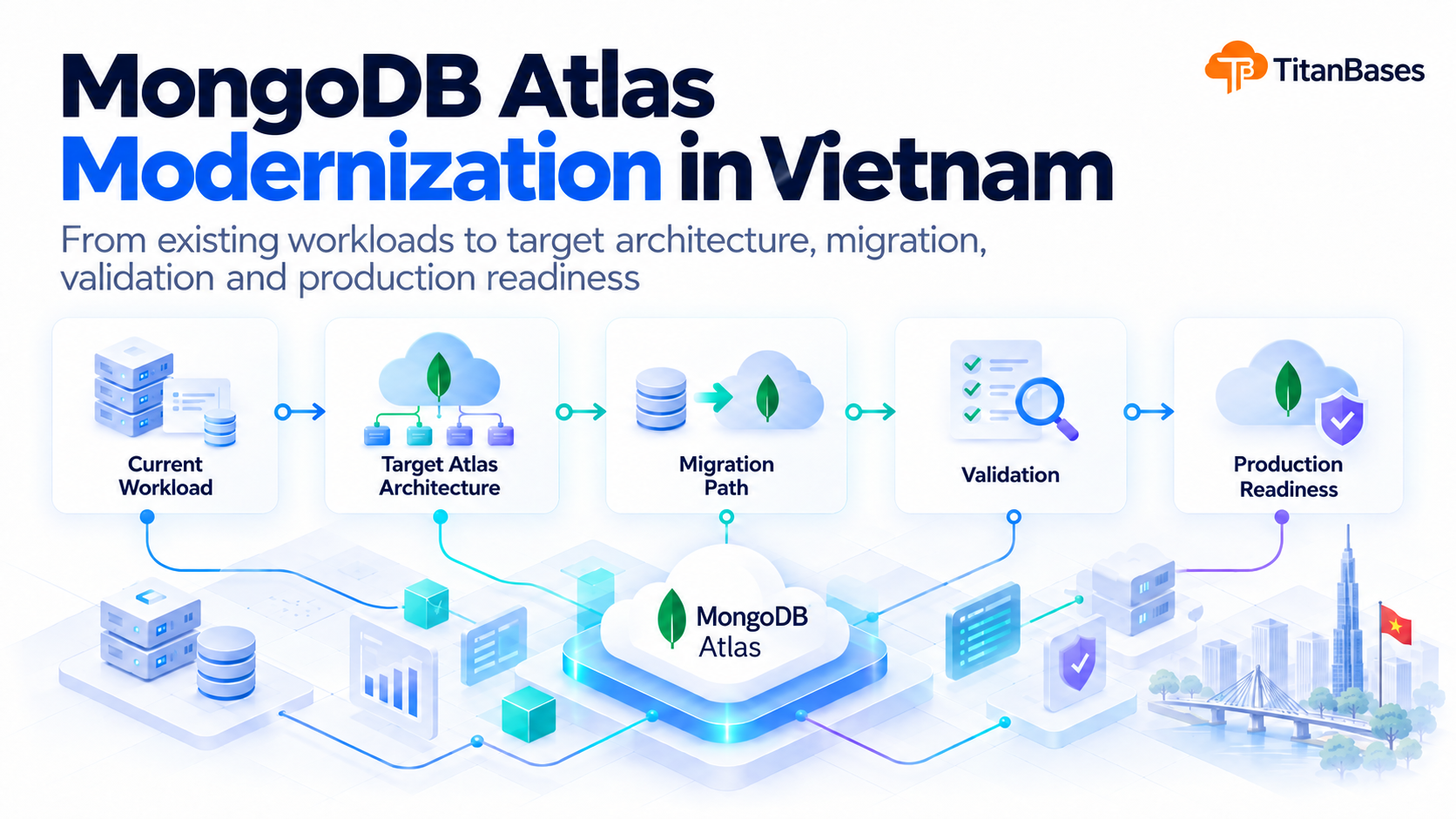
Moving MongoDB from a self-managed environment to MongoDB Atlas can look straightforward when described at a high level: provision a target environment, move the data, update application connectivity, and switch production traffic. In practice, enterprise modernization is more complex. A production MongoDB environment is connected to applications, identity systems, networks, security controls, operational processes, backup policies, monitoring, deployment pipelines, and business-critical workflows. Changing the database operating model therefore changes more than the database itself. For enterprises in Vietnam evaluating MongoDB Atlas, the more useful question is not simply: “Can this database be migrated?” It is: “How do we transition the full production data platform without creating unacceptable application, security, operational, or business risk?” That distinction is the foundation of a successful modernization program.
MongoDB Modernization Is More Than Data Movement
Database migration is often discussed primarily as a data-transfer problem. Data movement is important, but it is only one part of the transition. A production MongoDB modernization typically affects several layers simultaneously:
- database topology;
- application connection behavior;
- networking;
- authentication and authorization;
- encryption and key-management requirements;
- backup and recovery;
- observability;
- operational ownership;
- deployment processes;
- change management;
- incident response.
The target platform must therefore be assessed as part of the broader application architecture. A technically successful data copy is not enough if applications cannot connect securely, production traffic behaves differently, monitoring is incomplete, or the operations team does not understand the new operating model. This is why TitanBases approaches MongoDB modernization as a production-platform transition rather than a database-copy exercise.
Step 1: Understand the Existing MongoDB Environment
Before selecting a migration path, teams need a reliable picture of the current state. The assessment should begin with the database environment itself. Typical areas include:
Deployment topology
Understand whether the environment uses:
- standalone deployments;
- replica sets;
- sharded clusters;
- multiple independent MongoDB deployments;
- development, staging, and production environments.
The target architecture should reflect the workload's actual availability, scaling, and operational requirements rather than simply reproducing the existing topology without analysis.
MongoDB version and compatibility
Review:
- MongoDB server version;
- drivers;
- application libraries;
- deprecated behavior;
- configuration dependencies;
- feature compatibility.
Application compatibility should be validated before migration rather than discovered during production cutover.
Workload characteristics
Understand:
- dataset size;
- working-set behavior;
- read/write patterns;
- peak traffic;
- connection counts;
- index usage;
- query patterns;
- batch workloads;
- background processing;
- growth expectations.
Sizing a target environment without understanding workload behavior creates unnecessary production risk.
Operational dependencies
Document the systems around MongoDB:
- backup workflows;
- monitoring tools;
- alerting;
- automation scripts;
- access-control processes;
- CI/CD dependencies;
- infrastructure automation;
- operational runbooks.
A modernization project should identify which of these processes will remain, which will change, and which will be replaced by platform-native capabilities.
Step 2: Design the Target Atlas Architecture
Modernization should start with the target operating model rather than with the migration tool. The Atlas environment needs to be designed around the production requirements of the application. Important considerations include:
Organization and project structure
Define how Atlas resources should be organized across:
- teams;
- applications;
- environments;
- business units;
- production and non-production workloads.
The structure should support operational ownership, separation of duties, and manageable access control.
Cluster architecture
Select an architecture appropriate to:
- workload scale;
- resilience requirements;
- availability objectives;
- expected growth;
- read and write patterns.
Avoid treating cluster sizing as a one-time infrastructure decision. Production workloads evolve. The target environment should therefore support a practical path for future scaling and operational adjustment.
Region and cloud selection
Region selection should consider:
- application proximity;
- network latency;
- existing cloud architecture;
- regulatory requirements;
- service availability;
- disaster-recovery strategy;
- organizational cloud standards.
Do not make assumptions about data residency or regulatory compliance based solely on geographic proximity. Those requirements need to be evaluated against the organization's actual legal, security, and governance obligations.
Step 3: Design Networking Before Moving Data
Networking is one of the areas most likely to create problems when migration planning begins too late. Applications need a secure and predictable path to the new database environment. Depending on the architecture and supported platform capabilities, this may involve:
- private connectivity;
- cloud networking;
- IP access controls;
- DNS behavior;
- routing;
- firewall rules;
- outbound connectivity;
- application subnets;
- hybrid connectivity.
Connectivity should be tested from the actual application environment rather than only from an engineer's workstation. Teams should verify:
- name resolution;
- network routes;
- connection establishment;
- TLS behavior;
- firewall policies;
- connection pooling;
- expected latency;
- failure behavior.
Production cutover should not be the first time the application attempts to reach Atlas through its intended network path.
Step 4: Rebuild Security as Part of the Platform
Security configuration should be treated as part of architecture, not as a final migration checklist. A MongoDB environment may contain multiple security layers:
- database users;
- application identities;
- administrator access;
- service accounts;
- network restrictions;
- encryption;
- secrets management;
- audit requirements;
- operational access.
When moving to Atlas, teams should map the existing access model to the target platform. The goal is not simply to recreate every historical permission. Modernization provides an opportunity to review whether access remains appropriate. Questions to address include:
- Which applications require database access?
- Which teams need administrative access?
- Which credentials are machine identities?
- Where are database secrets stored?
- How are credentials rotated?
- What audit evidence is required?
- Which paths should be private?
- How is privileged access controlled?
The security model should be validated before production traffic is moved.
Step 5: Choose the Migration Strategy Around Business Risk
There is no single migration strategy appropriate for every MongoDB workload. The migration method depends on factors such as:
- dataset size;
- acceptable downtime;
- topology;
- application architecture;
- network bandwidth;
- MongoDB version;
- operational constraints;
- rollback requirements.
Use currently supported MongoDB tooling and migration approaches verified against official MongoDB documentation. Do not select a migration tool first and force the workload into that method. Instead, determine the acceptable business interruption and design the migration around it. A useful planning model separates migration into:
- initial data movement;
- synchronization or change handling where applicable;
- application validation;
- production cutover;
- post-cutover verification;
- rollback window.
The complexity lies not only in copying data but in controlling the transition between two production states.
Step 6: Validate the Application, Not Only the Database
A migration can pass database-level checks and still fail at the application layer. Validation should therefore include real application behavior. Typical checks include:
- application connectivity;
- authentication;
- connection pooling;
- query behavior;
- indexes;
- read and write paths;
- transactions where applicable;
- background jobs;
- scheduled workloads;
- APIs;
- reporting workloads;
- operational scripts;
- error handling.
Performance testing should focus on representative workloads rather than synthetic database operations alone. The objective is to determine whether the complete application behaves correctly against the target environment. For a workload-specific example of evaluation, see TitanBases’ MongoDB Atlas Vector Search engineering analysis of a 10M-vector eKYC proof of concept. This is particularly important when the migration also changes:
- network paths;
- deployment regions;
- connection strings;
- authentication methods;
- infrastructure topology;
- operational tooling.
Step 7: Treat Cutover as an Engineering Event
Production cutover should be planned as a controlled engineering event. A cutover plan should identify:
- decision owners;
- migration sequence;
- application freeze requirements;
- synchronization status;
- validation checkpoints;
- traffic-switch procedure;
- communication channels;
- rollback conditions;
- rollback owners;
- acceptance criteria.
The most important question is not: "When do we switch?" It is: "What evidence tells us the production environment is safe to switch?" Clear go/no-go criteria reduce ambiguity during the migration window.
Rollback Is Part of the Migration Design
Rollback planning is often treated as an emergency procedure. It should instead be designed from the beginning. Before cutover, teams should know:
- what conditions trigger rollback;
- whether data written after cutover can be reconciled;
- how application configuration is reverted;
- how network changes are reversed;
- whether the original environment remains available;
- how long the rollback window remains valid.
A migration without a realistic rollback model creates unnecessary operational risk. The objective is not to expect failure. The objective is to make failure recoverable.
Step 8: Establish Production Observability
Modernization changes the operational model. Teams therefore need visibility into both database behavior and application behavior after cutover. Production monitoring should consider:
- resource utilization;
- connection behavior;
- query performance;
- slow operations;
- replication health;
- storage growth;
- alerts;
- application errors;
- infrastructure dependencies.
Observability should be established before migration rather than added after a production problem occurs. The operations team should know:
- which signals matter;
- where alerts go;
- who responds;
- what constitutes normal behavior;
- how incidents are investigated.
A managed platform reduces some operational work, but it does not eliminate the need for operational ownership.
Step 9: Revisit Backup and Recovery
Backup configuration should not simply mirror historical habits. Modernization is an opportunity to redefine recovery requirements. Organizations should identify:
- recovery-point objectives;
- recovery-time objectives;
- retention requirements;
- restore procedures;
- recovery testing;
- administrative access during incidents.
A backup is only useful if the organization knows how to restore from it. Recovery testing should therefore be part of production readiness.
Atlas or Enterprise Advanced?
MongoDB Atlas is not automatically the correct deployment model for every organization. Some workloads may need a self-managed operating model because of:
- infrastructure-control requirements;
- deployment constraints;
- regulatory requirements;
- network isolation;
- existing platform standards;
- operational policies.
MongoDB Enterprise Advanced may therefore remain appropriate for certain environments. Other organizations may prefer Atlas because they want to reduce infrastructure-management responsibilities and adopt a managed database platform. The architectural decision should be based on workload and organizational requirements rather than a generic preference for cloud or self-managed infrastructure. For enterprises evaluating the two approaches, the decision framework should consider:
- operating model;
- infrastructure ownership;
- security requirements;
- regulatory requirements;
- deployment location;
- scalability;
- operational staffing;
- observability;
- backup and recovery;
- integration with the surrounding application platform.
Modernization is therefore not always synonymous with moving every workload to the same destination. Organizations evaluating Atlas as an operating model may also need to review how Atlas is procured and billed in Vietnam; TitanBases describes its direct billing path separately.
MongoDB Modernization in Vietnam
For enterprises in Vietnam, modernization projects often take place inside broader cloud, application, and data-platform transformation programs. MongoDB may already support business-critical applications while surrounding infrastructure changes. That creates an important architectural dependency. Database modernization cannot be planned independently from:
- cloud strategy;
- application architecture;
- network design;
- enterprise security;
- platform engineering;
- data governance;
- operational responsibilities.
This is particularly relevant as Vietnamese organizations introduce more real-time applications, digital services, automation, analytics, and AI capabilities. These systems increasingly depend on operational data being available through reliable production platforms. The role of a modern data platform is therefore not merely to store information. It is to make operational data usable by applications while maintaining the availability, security, performance, and governance requirements of the enterprise.
From Database Migration to Operational Data Platform
A successful MongoDB modernization should leave the organization with more than a relocated database. The target state should be an operational data platform that teams understand how to run. That means the organization has:
- a defined architecture;
- secure connectivity;
- controlled access;
- documented ownership;
- observable workloads;
- tested recovery;
- repeatable deployment processes;
- production runbooks;
- clear escalation paths.
This is the difference between completing a migration and completing a modernization. Migration moves data. Modernization changes how the system is engineered and operated.
TitanBases and MongoDB Production Engineering
TitanBases works across Cloud & Infrastructure, Data Platforms, AI & Automation, and Platform Engineering. MongoDB modernization sits directly at the intersection of these disciplines. A database migration can involve:
- cloud architecture;
- networking;
- database engineering;
- security;
- application integration;
- deployment automation;
- production operations.
For this reason, TitanBases approaches MongoDB projects as part of the full application and platform architecture rather than as isolated database administration. As a MongoDB partner, TitanBases supports enterprises evaluating production deployment models, MongoDB Atlas modernization, operational data platforms, and the engineering work required to move database workloads safely into their target environment. The objective is not simply to move MongoDB. It is to help create a production platform that applications and engineering teams can operate with confidence. Cloud. Data. AI. Engineered for production.
Frequently Asked Questions
What is MongoDB Atlas modernization?
MongoDB Atlas modernization is the process of moving or redesigning MongoDB workloads around a managed cloud database operating model. It can include architecture, networking, security, migration, application integration, observability, backup, recovery, and production operations - not only data transfer.
Is migrating MongoDB to Atlas the same as moving the database?
No. Data movement is only one part of a production migration. Applications, network connectivity, identity, security, monitoring, backup, deployment processes, and operational ownership also need to be validated.
Should every MongoDB workload move to Atlas?
Not necessarily. MongoDB Atlas can be appropriate for organizations that want a managed operating model, while some workloads may require self-managed infrastructure or MongoDB Enterprise Advanced because of technical, operational, security, or regulatory requirements.
How should enterprises reduce risk during MongoDB migration?
Enterprises should assess the current environment, design the target architecture, validate networking and security, select an appropriate migration method, test application behavior, define cutover criteria, prepare rollback procedures, and establish monitoring before moving production traffic.
Does TitanBases support MongoDB Atlas modernization in Vietnam?
TitanBases works with enterprises on MongoDB architecture, Atlas modernization, operational data platforms, cloud infrastructure, application integration, and production engineering as part of its broader Cloud, Data, AI, and Platform Engineering capabilities.
Modernizing MongoDB for production? TitanBases helps enterprises design MongoDB architectures, modernize to Atlas, integrate operational data platforms, and prepare workloads for production.
Explore Data Platforms