From AI PoC to Production: An Enterprise Architecture for OpenAI Applications
Moving an OpenAI proof of concept into production requires more than connecting an application to a model API. This engineering guide explores the architecture needed to connect models with enterprise data, retrieval, tools, security controls, evaluation and production operations.
Published Sep 25, 2026
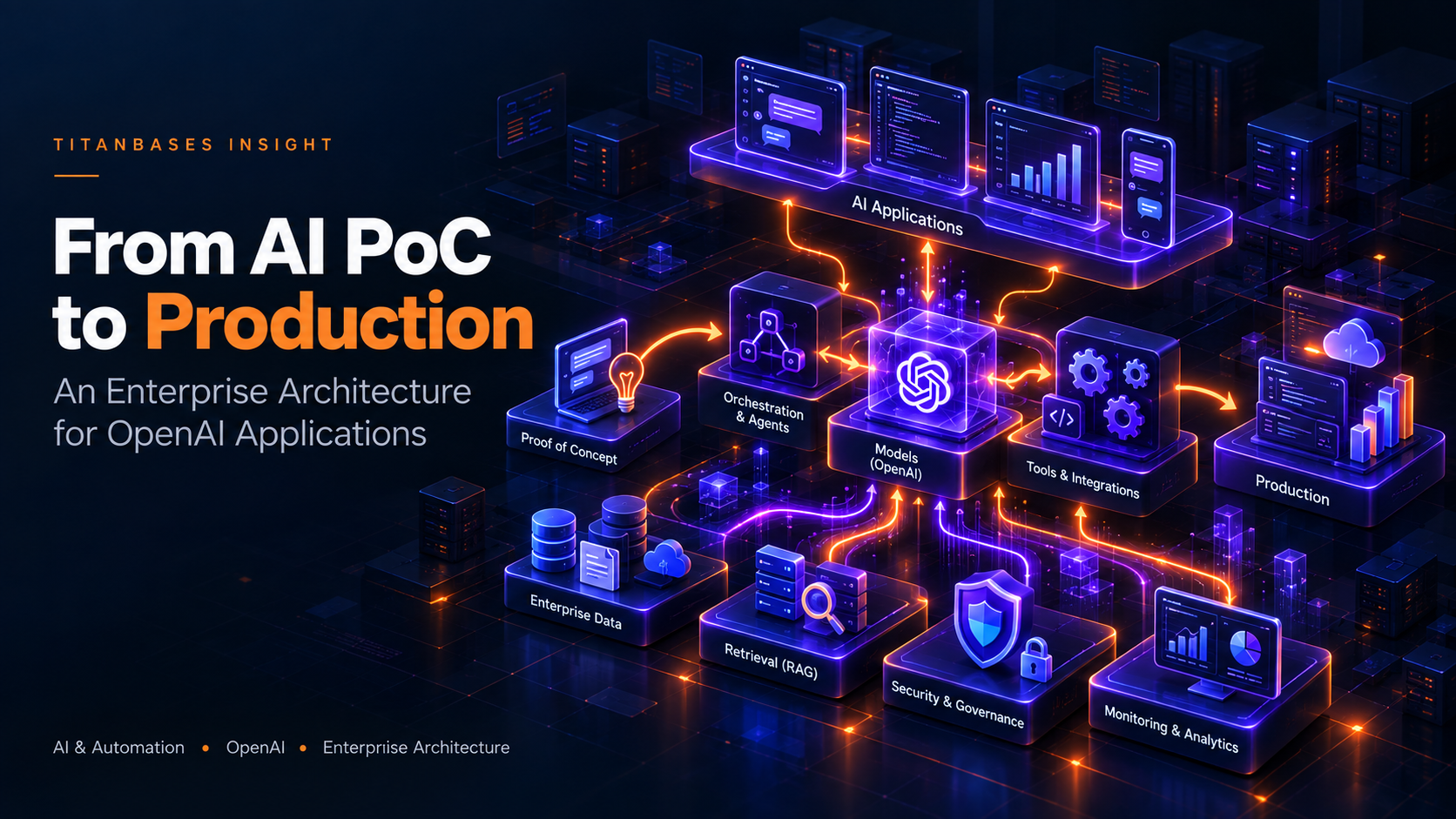
Add approved article content beAn AI proof of concept can often be built around a relatively simple interaction with a model. Moving that application into production is a different engineering problem. Production systems must connect models with enterprise data, applications, APIs and operational workflows while addressing identity, permissions, reliability, evaluation, observability and failure handling. The architecture therefore needs to extend beyond the model. A production AI application is a distributed application system in which the model is one component of a broader engineering architecture.fore publishing.
From AI Demo to Production System
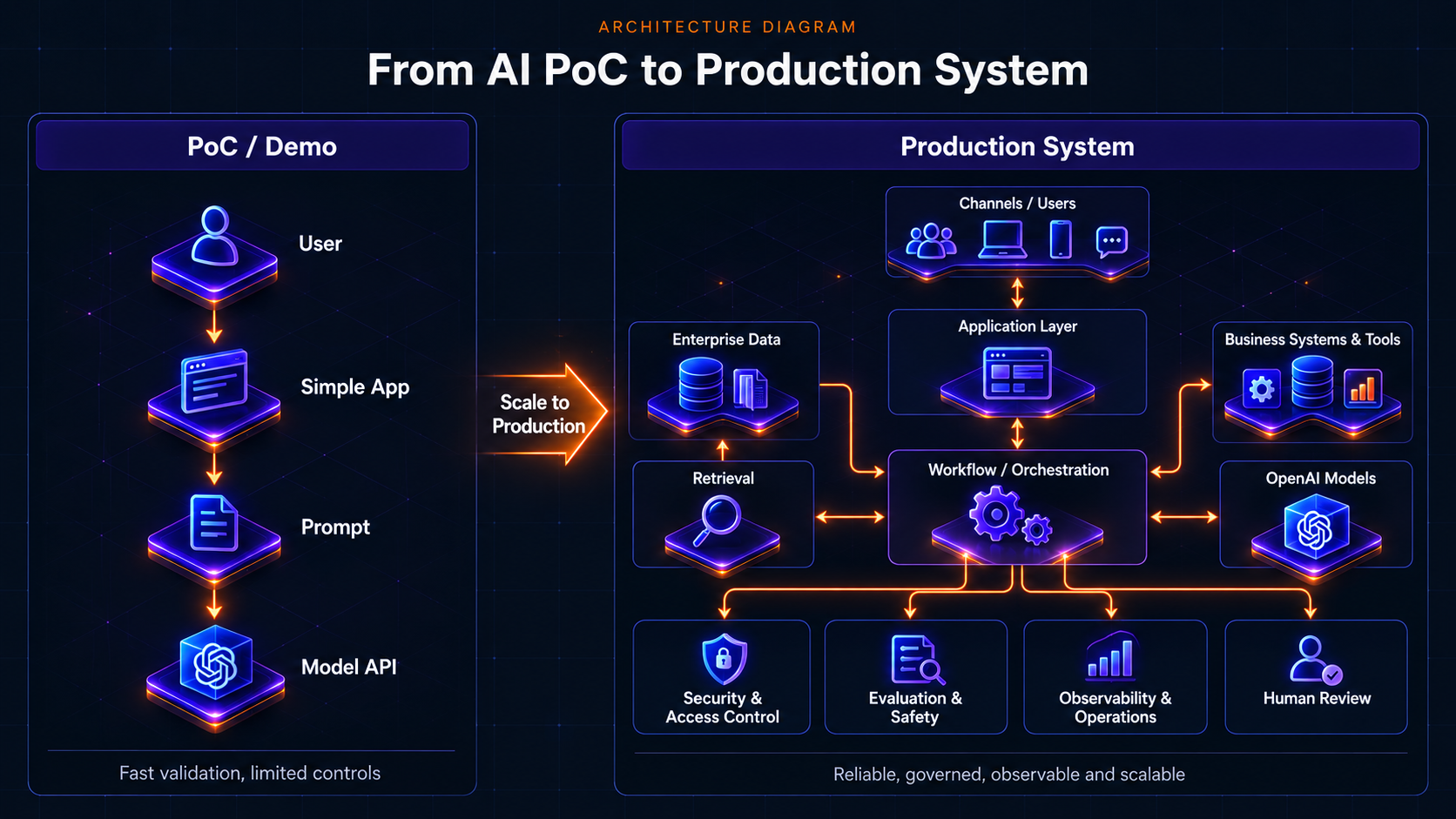
A proof of concept typically answers a narrow question: can the model perform the intended task? Production introduces a broader set of requirements. The system must retrieve the right enterprise context, interact safely with existing applications, enforce user and data permissions, handle failures, provide operational visibility and allow model behavior to be evaluated over time. This changes the engineering objective from demonstrating model capability to operating a complete AI system reliably under real production conditions.
A Reference Architecture for Enterprise OpenAI Applications
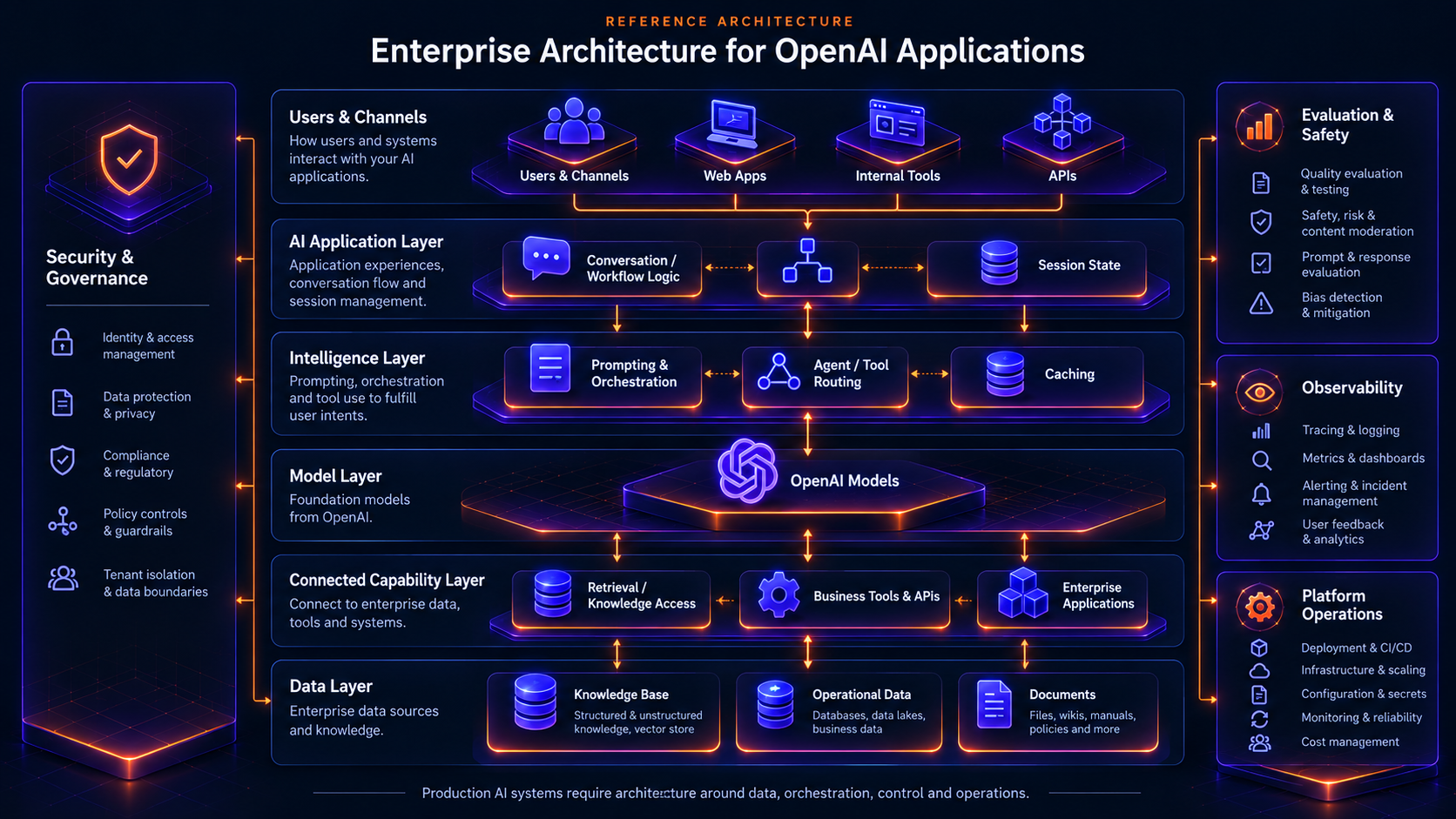
A practical enterprise OpenAI architecture can be understood as seven connected engineering responsibilities. Together, they define how users interact with the application, how model intelligence is orchestrated, how enterprise context and tools are connected, and how the resulting system is secured, evaluated and operated.
- Experience Layer — user interfaces, applications and APIs.
- Application & Orchestration Layer — workflow control, context assembly, model interaction and tool coordination.
- Model Layer — OpenAI models selected according to workload requirements.
- Enterprise Context & Retrieval — operational data, documents, search and retrieval systems.
- Tools & Enterprise Systems — APIs and business systems the AI application may interact with.
- Security & Governance — identity, authorization, data boundaries and operational controls.
- Evaluation, Observability & Operations — measurement, tracing, monitoring and continuous improvement.
1. Experience Layer
The experience layer is where users or other systems interact with the AI application. Depending on the workload, this may include enterprise web applications, internal assistants, customer-facing applications, mobile experiences, application APIs or automated workflows. Before a request reaches AI orchestration, the application should establish context such as the authenticated user, session, workload and permitted actions. The objective is to embed AI within a controlled application experience rather than expose unrestricted model access as the application itself.
2. Application & Orchestration Layer
The orchestration layer acts as the control plane of the AI application. It determines how an incoming request becomes an executable workflow. Responsibilities can include request routing, instruction management, context assembly, model selection, retrieval orchestration, tool execution, structured output handling, workflow state, retries, fallbacks and human approval checkpoints. A simple workload may involve only a model interaction. A more complex enterprise workflow may require several coordinated steps across data, models, tools and business systems.
User request → enterprise context → model reasoning → tool request → enterprise system → model response → application
3. Model Layer: OpenAI
The model layer provides the intelligence required by the workload. Depending on the application, OpenAI models may support reasoning, generation, classification, extraction, summarization, multimodal understanding, structured outputs and tool-enabled workflows. Model selection should follow workload requirements rather than assuming that one model is appropriate for every task. Different operations may require different trade-offs. The surrounding architecture should therefore keep model configuration testable and replaceable.
4. Enterprise Context & Retrieval
Enterprise AI becomes substantially more useful when an application can operate with relevant organizational context. That context can exist across operational databases, document repositories, knowledge bases, object storage, search systems, vector indexes, application databases and internal APIs. Retrieval-Augmented Generation is one pattern for connecting this information to a model, but retrieval infrastructure alone does not guarantee useful grounding.
- Operational databases
- Document repositories
- Knowledge bases
- Object storage
- Search systems
- Vector indexes
- Application databases
- Internal APIs
The engineering challenge is to retrieve the right information for the right user at the right time. That requires the system to consider authorization, data freshness, metadata, filtering, ranking, retrieval quality and source traceability as part of the retrieval architecture.
User query → authorization context → retrieval → filtering and ranking → context assembly → OpenAI model
5. Tools & Enterprise Systems
Retrieval allows an AI application to access relevant information. Tools allow it to initiate controlled actions. An enterprise AI workflow may interact with CRM platforms, ticketing systems, databases, internal APIs, document systems, workflow engines or other business applications. The distinction matters: model reasoning can determine that an action is useful, but the authority to perform that action should remain inside the surrounding application architecture.
- CRM platforms
- Ticketing systems
- Databases
- Internal APIs
- Document systems
- Workflow engines
- Enterprise applications
Model requests action → application validates request → authorization is evaluated → tool executes → result returns to orchestration → workflow continues
6. Security & Governance
AI applications inherit traditional application-security requirements while introducing additional trust boundaries around models, retrieved context and tool execution. The central question is not only what the model can do, but what a specific user and workload should be permitted to retrieve or execute. Security therefore needs to exist around the AI system rather than relying on natural-language behavior inside the model.
- Identity — who is making the request?
- Authorization — what may that identity access?
- Data boundaries — which enterprise information may enter the workflow?
- Tool permissions — which operations can the system perform?
- Secrets — how are credentials and service identities protected?
- Auditability — can important actions be reconstructed?
- Human control — which actions require explicit approval?
7. Evaluation, Observability & Operations
Traditional application monitoring remains necessary for AI systems, but it does not fully describe whether an AI workflow is behaving correctly. An API request can complete successfully while the resulting answer, retrieval result or tool decision is still unsuitable for the intended workload. Production AI therefore needs visibility into both system behavior and AI behavior.
System observability
- Request latency
- Model latency
- Errors and retries
- Token consumption
- Retrieval performance
- Tool execution
- Application availability
AI evaluation
- Task success
- Answer quality
- Retrieval quality
- Grounding
- Instruction adherence
- Tool selection
- Workflow completion
Together, observability and evaluation create a continuous production loop: Observe → Evaluate → Diagnose → Improve → Re-evaluate → Deploy
Designing for Failure
Production architecture should assume that individual AI components can fail. Retrieval may return irrelevant context. A model may produce an unusable response. Structured output may fail validation. A tool may become unavailable. An external system may time out. A request may reach a permission boundary. The objective is not to assume that the model will always behave correctly. It is to design a system whose behavior remains controlled when an individual component does not.
- Validation
- Retry policies
- Bounded tool execution
- Fallback paths
- Graceful degradation
- Deterministic business rules
- Human escalation
A Practical Path from PoC to Production
A production architecture does not need to be implemented in full on the first day. Teams can introduce engineering controls progressively as the workload becomes better understood.
- Define the workload — Identify the user, task, expected outcome and boundaries of the AI system.
- Establish an evaluation baseline — Define representative examples and determine what acceptable behavior means.
- Validate model capability — Test whether the selected model can perform the core workload at the required quality.
- Connect trusted context — Introduce enterprise data and retrieval where the workload requires grounded information.
- Integrate tools — Connect external actions through explicit application interfaces and permission boundaries.
- Add production controls — Introduce identity, authorization, validation, logging, fallback behavior and approval gates.
- Observe and evaluate — Capture system telemetry and AI behavior so failures and regressions can be investigated.
- Deploy progressively — Move from controlled testing toward production workloads while continuing evaluation against operating conditions.
What Changes When AI Reaches Production?
A proof of concept asks: Can the model solve this task? Production asks: Can the complete system solve this task reliably, securely and repeatedly under real operating conditions?
The model remains important, but production quality increasingly depends on the architecture surrounding it. Enterprise Data + Retrieval + Models + Tools + Application Logic + Security + Evaluation + Observability = Production AI System
Where This Architecture Applies
- Enterprise Knowledge Assistants — Ground responses in approved organizational knowledge.
- Retrieval-Augmented Generation — Connect models with enterprise search and operational data.
- AI Agents & Tool Use — Coordinate controlled actions across applications and APIs.
- Document Intelligence — Extract and interpret information before routing it into business workflows.
- Customer & Employee Assistants — Embed AI capabilities into existing digital experiences and internal applications.
- Workflow Automation — Combine model reasoning, application logic, enterprise tools and human approval.
The implementations differ, but the production concerns around data, permissions, evaluation, observability and operational control remain closely related.
Engineering OpenAI Applications for Production
OpenAI provides model and platform capabilities for building AI applications. The enterprise engineering challenge is integrating those capabilities with organizational data, applications, security boundaries and production operations. At TitanBases, we approach this problem across four connected engineering domains.
- AI & Automation — model integration, agents, retrieval and AI workflows. AI & Automation → /solutions/ai-automation
- Data Platforms — operational data, search and retrieval foundations. Data Platforms → /solutions/data-platforms
- Cloud & Infrastructure — scalable and resilient runtime foundations. Cloud & Infrastructure → /solutions/cloud-infrastructure
- Platform Engineering — delivery, observability and production operations. Platform Engineering → /solutions/managed-services
Key Takeaways
Building an OpenAI application beyond the PoC stage? TitanBases designs and engineers production AI systems that connect models with enterprise data, applications, tools and operational platforms.
Explore AI & Automation