Designing Production AWS Foundations: From Landing Zones to Resilience and Operations
Production AWS environments need more than cloud resources. TitanBases approaches landing zones, workload architecture, resilience, automation, observability and operations as one connected engineering system.
Published Sep 25, 2026 · Updated Sep 25, 2026
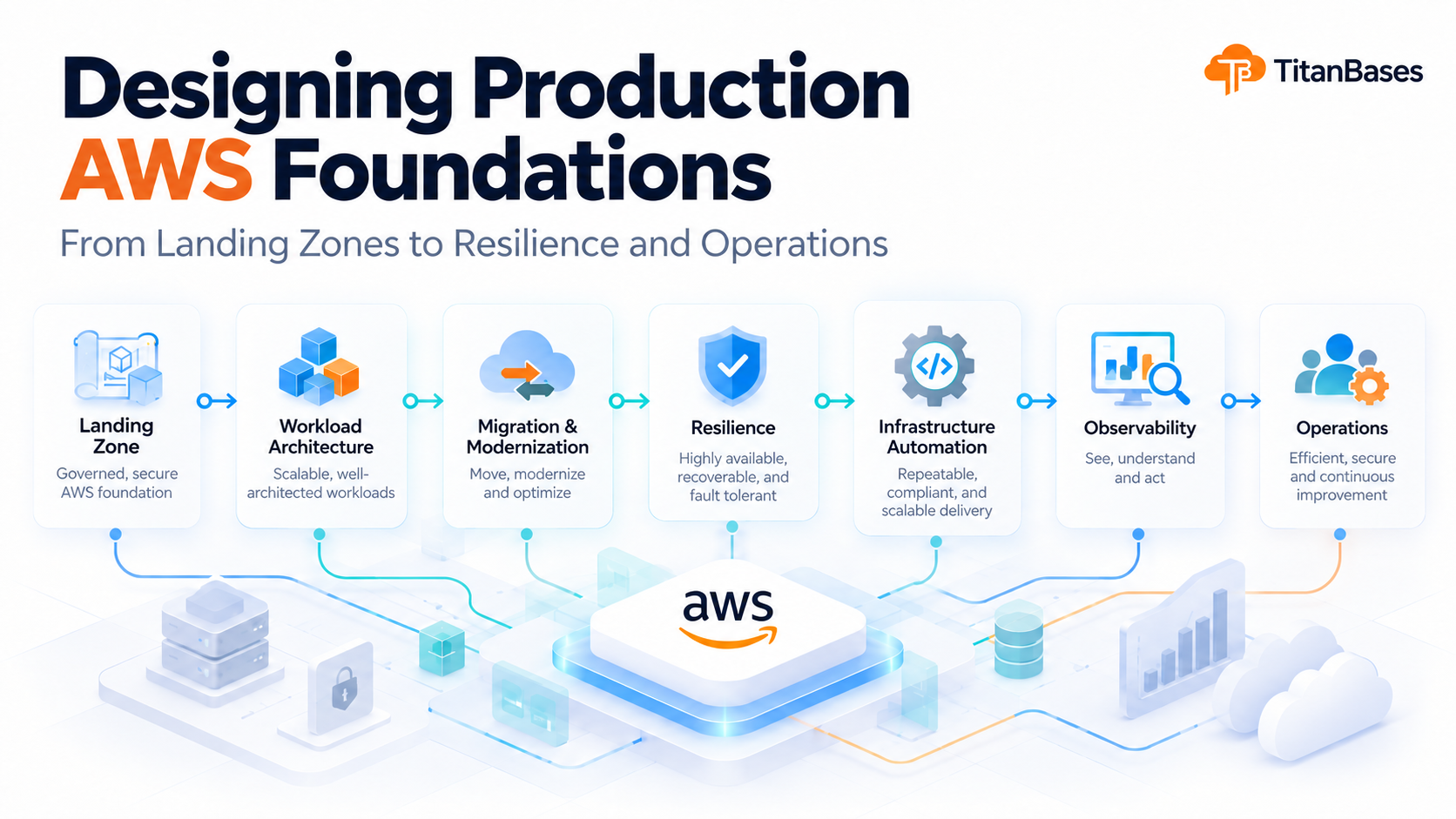
Production AWS environments are not defined by the number of cloud services deployed. They are defined by whether workloads can be deployed, secured, observed, recovered and operated consistently under real production conditions. A well-designed AWS foundation connects account structure, identity, networking, security, workload architecture, infrastructure automation, resilience and operational ownership. At TitanBases, we approach these elements as one connected engineering system rather than as independent infrastructure tasks.
Production Cloud Begins with a Foundation
AWS describes a landing zone as a well-architected environment that establishes foundational structures for operating workloads at scale. For enterprise environments, this foundation typically needs to address account organization, identity and access, network design, security controls, logging, governance and operational visibility before application workloads are introduced. The objective is not to create infrastructure for its own sake. It is to create a repeatable environment in which workloads can be deployed without redesigning foundational controls every time a new application arrives.
Landing Zones for Production Workloads
A landing zone establishes the baseline architecture within which AWS workloads operate. The exact design depends on organizational scale, workload sensitivity, existing infrastructure and governance requirements, but the architecture normally needs to establish clear boundaries between environments while preserving centralized visibility and control.
- Account and environment structure — organize workloads, environments and shared services around clear ownership boundaries.
- Identity and access — define authentication, authorization and privileged access patterns.
- Network architecture — establish connectivity, segmentation, routing and integration with external environments.
- Security foundations — introduce baseline controls, centralized logging and security visibility.
- Governance — define policies and guardrails that can scale across accounts and workloads.
- Operational visibility — provide telemetry and monitoring foundations before applications move into production.
Workload Architecture Comes Next
Once the cloud foundation exists, architecture decisions move closer to the workload. Different applications have different availability requirements, scaling patterns, data dependencies, integration boundaries and operational constraints. A customer-facing digital service, an internal business application and an AI workload may all run on AWS while requiring substantially different application architectures. TitanBases therefore starts workload design with application behavior rather than selecting individual cloud services first.
Typical workload questions include:
- How does traffic enter and move through the system?
- Which components must scale independently?
- Which workloads are stateful?
- What availability target does the business require?
- What happens when a dependency fails?
- Which systems remain outside AWS?
- What data or integration boundaries exist?
- Who operates the workload after deployment?
Migration Is an Architecture Transition
Cloud migration is often described as moving workloads from one environment to another. In practice, production migration also changes operational boundaries. Identity, networking, monitoring, backup, deployment, security and incident response may all need to transition alongside the application. AWS guidance emphasizes establishing and validating the landing zone before migration so teams can focus on workload movement without simultaneously rebuilding foundational controls.
- Assess — understand the workload, dependencies, current operating model and constraints.
- Establish foundation — confirm accounts, identity, connectivity, security and logging.
- Design target architecture — determine how the workload should operate in AWS.
- Prepare migration path — define sequencing, data movement, cutover and fallback.
- Validate — test application behavior, connectivity, security and recovery.
- Transition — move workloads through a controlled release process.
- Operate — establish production ownership and monitoring.
- Modernize — improve architecture after stable operation where modernization creates meaningful value.
Designing for Resilience
Resilience begins by deciding what failures the system must tolerate. Infrastructure redundancy is only one part of that design. Production architecture should consider application behavior, data durability, dependency failure, recovery objectives, backup strategy and operational response. The objective is not to make failure impossible. It is to ensure that expected failure conditions do not become uncontrolled business events.
- High availability
- Fault isolation
- Backup and restore
- Disaster recovery
- Dependency failure handling
- Capacity planning
- Recovery procedures
- Incident readiness
Infrastructure as Code and Delivery Automation
Production environments become difficult to control when infrastructure is created differently for every workload or changed manually without repeatable configuration. Infrastructure as Code and delivery automation create a more consistent path for provisioning, updating and validating infrastructure. TitanBases uses automation as an engineering control: the goal is repeatability, reviewability and predictable change rather than automation for its own sake.
- Repeatable environment provisioning
- Infrastructure version control
- Reviewable configuration changes
- CI/CD integration
- Environment consistency
- Reduced configuration drift
- Controlled rollback and recovery paths
Observability Before Incidents
Monitoring should not begin after a production incident. Applications, infrastructure and platforms need enough telemetry to explain what the system is doing before engineers need to diagnose a failure. Production observability should help teams answer questions about availability, latency, resource behavior, application dependencies and changes across the environment.
From Deployment to Operational Ownership
Deployment is not the end of cloud engineering. Production workloads continue to change as traffic grows, dependencies evolve, new releases are introduced and business requirements shift. Operational ownership establishes who monitors the system, responds to incidents, manages capacity, reviews cost and evolves the architecture over time.
- Monitoring and alerting
- Incident response
- Capacity management
- Security operations
- Backup and recovery verification
- Cost visibility
- Change management
- Continuous architecture improvement
A Practical AWS Engineering Lifecycle
- Discover — understand workload, business and operating requirements.
- Architect — design foundation and workload architecture.
- Build — implement infrastructure and automation.
- Migrate or deploy — introduce the workload through controlled change.
- Validate — test security, performance, resilience and operations.
- Operate — establish visibility, ownership and incident readiness.
- Optimize — improve architecture, reliability and cost as workload behavior becomes clearer.
AWS Within the TitanBases Engineering Stack
- Cloud & Infrastructure — AWS foundations, workload runtime, networking and resilience.
- Data Platforms — operational data services supporting cloud applications.
- AI & Automation — AI workloads requiring secure and scalable infrastructure.
- Platform Engineering — CI/CD, infrastructure automation, observability and operational ownership.
Explore related practices: Cloud & Infrastructure, Data Platforms, AI & Automation, and Platform Engineering.
Key Takeaways
Building or modernizing production workloads on AWS? TitanBases designs cloud foundations, workload architectures and operating models around real production requirements.
Explore Cloud & Infrastructure