Enterprise OpenAI Implementation in Vietnam: From Use Case to Production
Enterprise OpenAI implementation requires more than model access. TitanBases helps organizations define use cases, design architecture, integrate enterprise data and tools, evaluate behavior and prepare workloads for production.
Published Sep 25, 2026 · Updated Sep 25, 2026
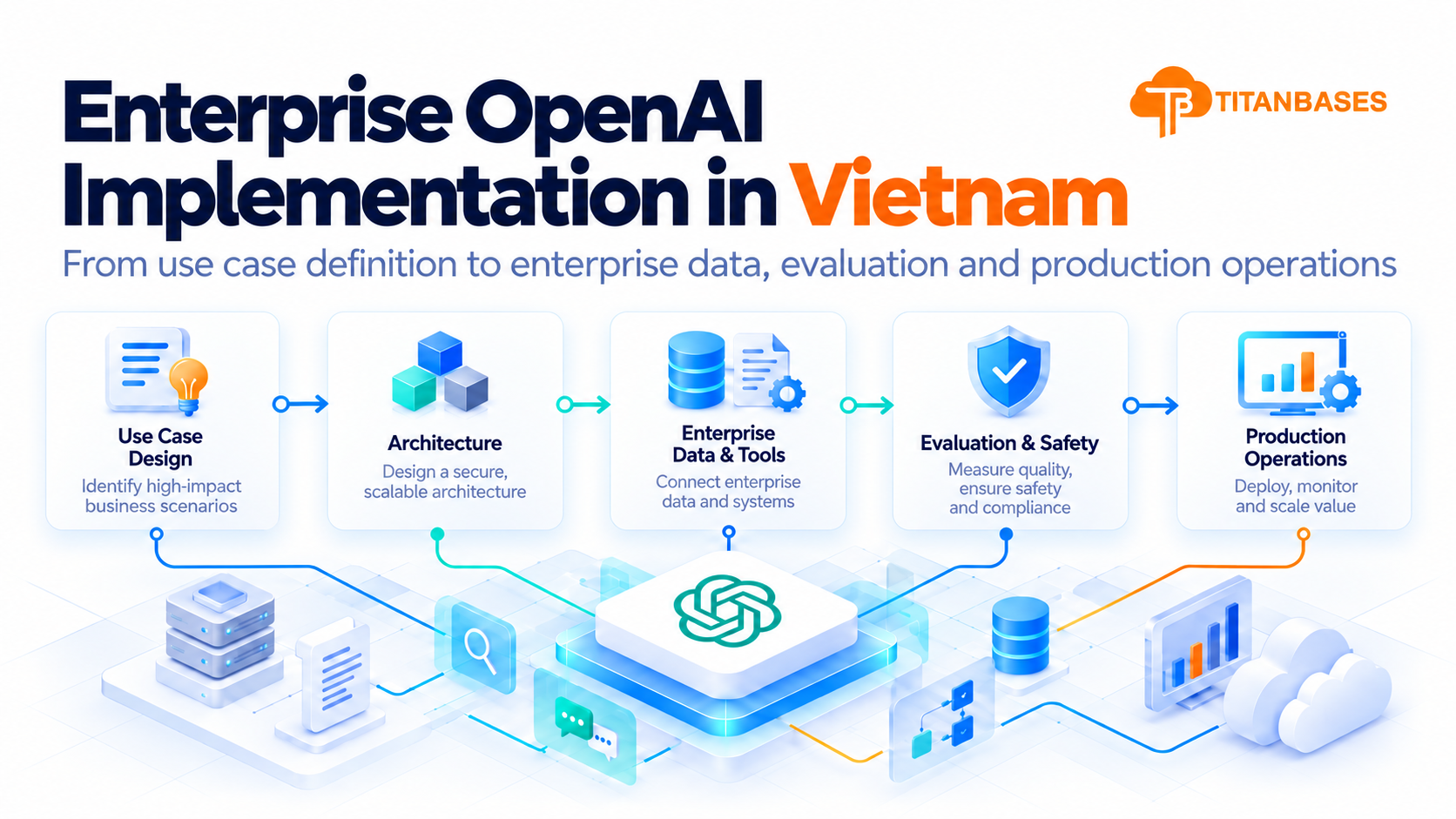
Implementing OpenAI in an enterprise environment is not the same as connecting an application to a model API. The implementation must connect model capabilities with business workflows, enterprise data, identity, application logic, tools, evaluations and production operations. For organizations in Vietnam evaluating enterprise AI, the central question is therefore not simply which model to use. It is how to turn a defined use case into a controlled production system.
Start with the Use Case
AI projects become difficult when the technical solution is selected before the business problem is defined. A useful discovery process identifies who will use the system, what task they need to complete, what information the system requires and what outcome should improve.
- Target users
- Business workflow
- Current pain point
- Expected outcome
- Required enterprise data
- Systems and APIs involved
- Risk and approval boundaries
- Production ownership
Choose the Right OpenAI Pattern
Different enterprise workloads require different AI patterns. Some use cases need a conversational interface. Others require document extraction, retrieval over enterprise knowledge, structured model output, tool execution or multi-step agent workflows. The implementation pattern should follow the workload rather than forcing every problem into the same chatbot architecture.
- Enterprise knowledge assistant
- Retrieval-Augmented Generation
- Document intelligence
- Structured extraction
- AI-powered application feature
- Tool-enabled assistant
- Workflow automation
- Agentic workflow
Design the Enterprise Architecture
Once the use case is understood, the architecture must define how models interact with the rest of the enterprise environment. A typical production architecture can include:
- User or application experience
- Application orchestration
- OpenAI models
- Enterprise data
- Search and retrieval
- Tools and APIs
- Identity and authorization
- Evaluations and guardrails
- Observability
- Production operations
Connect Trusted Enterprise Context
Many enterprise workloads depend on information that is not contained in the model itself. That context may exist across operational databases, documents, knowledge systems, internal APIs or application services. Retrieval-Augmented Generation can connect approved enterprise information with model workflows, but useful grounding depends on more than adding a vector database.
- Data source selection
- Metadata
- Authorization
- Chunking and indexing
- Search and retrieval
- Filtering and ranking
- Context assembly
- Source traceability
Integrate Tools and Business Systems
AI becomes more useful when applications can move beyond information retrieval and participate in controlled workflows. Tool integration can connect the AI application with APIs, business systems and operational services. However, model reasoning should remain separate from execution authority.
Model proposes action → application validates → authorization is checked → tool executes → result returns to the workflow
Evaluate Before Production
Traditional testing confirms whether software behaves as expected under defined conditions. AI systems also require evaluation of model and workflow behavior. Teams need representative examples that help determine whether the system produces acceptable results for the actual business workload.
- Task success
- Answer quality
- Retrieval quality
- Grounding
- Structured output validity
- Tool selection
- Instruction adherence
- Workflow completion
Prepare for Enterprise Production
Production readiness adds requirements that often do not exist in an initial prototype. The system needs to handle identity, data boundaries, failures, scaling, monitoring and operational ownership.
- Authentication
- Authorization
- Secrets management
- Data boundaries
- Guardrails
- Failure handling
- Scaling and latency
- Observability
- Incident readiness
- Change management
A Practical Implementation Path
- Discover — define the user, workflow and business outcome.
- Qualify — determine whether OpenAI is appropriate for the workload.
- Architect — define models, data, retrieval, tools and control boundaries.
- Prototype — validate the core solution pattern.
- Evaluate — test behavior against representative scenarios.
- Integrate — connect enterprise systems and workflows.
- Productionize — introduce security, scaling, observability and operational controls.
- Deploy — release through a controlled production path.
- Improve — monitor behavior and continuously refine the system.
Where TitanBases Helps
- Use-case discovery
- Solution architecture
- Model/API integration
- Enterprise retrieval
- Tool integration
- Evaluation design
- Security and guardrails
- Production readiness
- Platform integration
- Observability and operations
TitanBases combines AI & Automation with Data Platforms, Cloud & Infrastructure and Platform Engineering so the AI application can be designed as part of the wider production environment.
OpenAI Implementation in Vietnam
Vietnamese organizations evaluating enterprise OpenAI adoption face the same core engineering challenge as organizations elsewhere: connecting powerful model capabilities with trusted enterprise data, business systems and production controls. TitanBases provides a Vietnam-based engineering and partner engagement path for organizations that want to explore, validate and deploy OpenAI-enabled applications.
Related Engineering Guidance
For deeper architecture guidance, see From AI PoC to Production: An Enterprise Architecture for OpenAI Applications and TitanBases and the OpenAI Partner Network: From AI Use Case to Production Deployment.
Key Takeaways
Planning an enterprise OpenAI implementation in Vietnam? TitanBases can help define the workload, design the architecture, validate the solution pattern and prepare the system for production.
Explore AI & Automation