TitanBases and the OpenAI Partner Network: From AI Use Case to Production Deployment
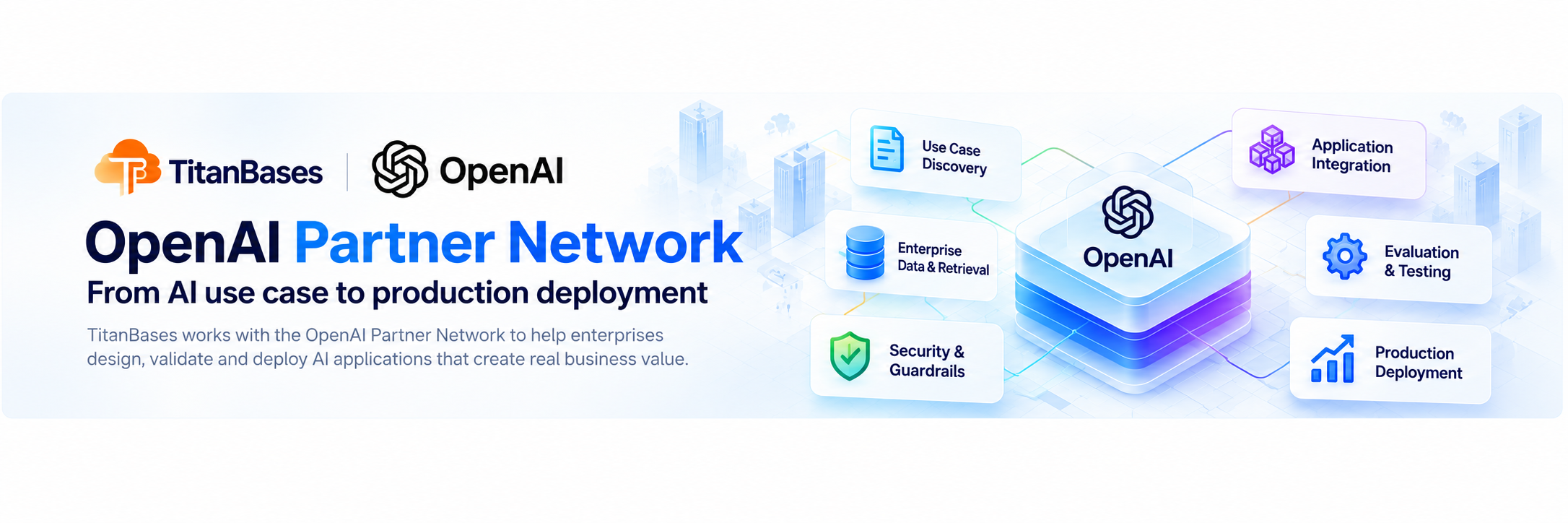
TitanBases works through the OpenAI Partner Network to help enterprises move from AI use-case discovery to production-ready architectures across models, enterprise data, retrieval, tools, evaluation and operational controls.
Published Sep 25, 2026 · Updated Sep 25, 2026
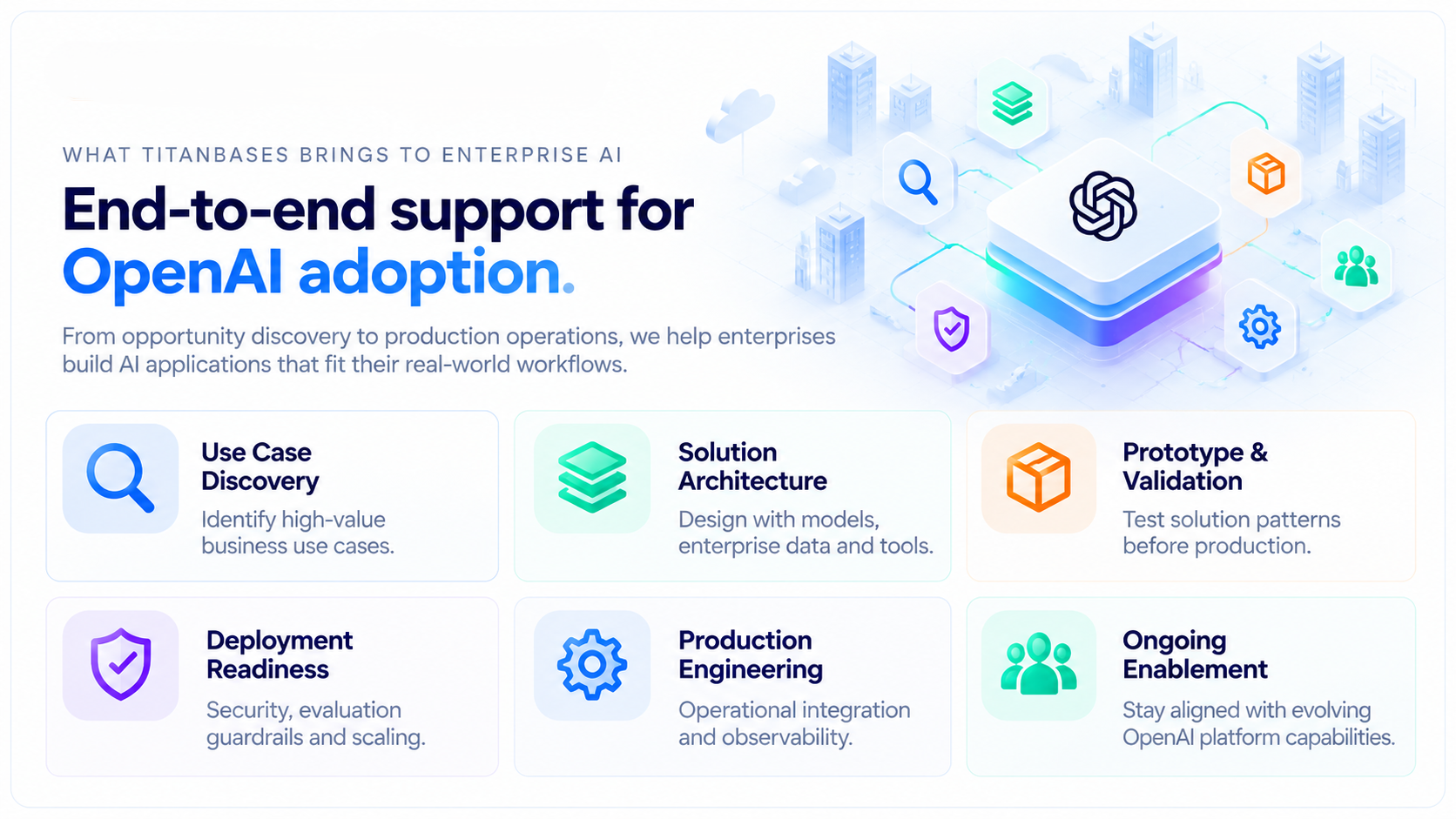
TitanBases is a Vietnam-based technology solutions and engineering company working with the OpenAI Partner Network to help enterprises move from AI experimentation toward production deployment. The customer work starts with a defined use case and extends through solution architecture, enterprise data and tool integration, evaluation, security controls and production operations.
What Customers Gain from an OpenAI Partner Network Relationship
For an enterprise, the practical value is a route from a promising AI idea to an application that can be evaluated, integrated and operated. TitanBases can help define the use case, design the surrounding system, validate a solution pattern and plan deployment. The OpenAI Partner Network relationship can support coordination with OpenAI for appropriate opportunities, subject to the customer’s choice and the needs of the engagement.
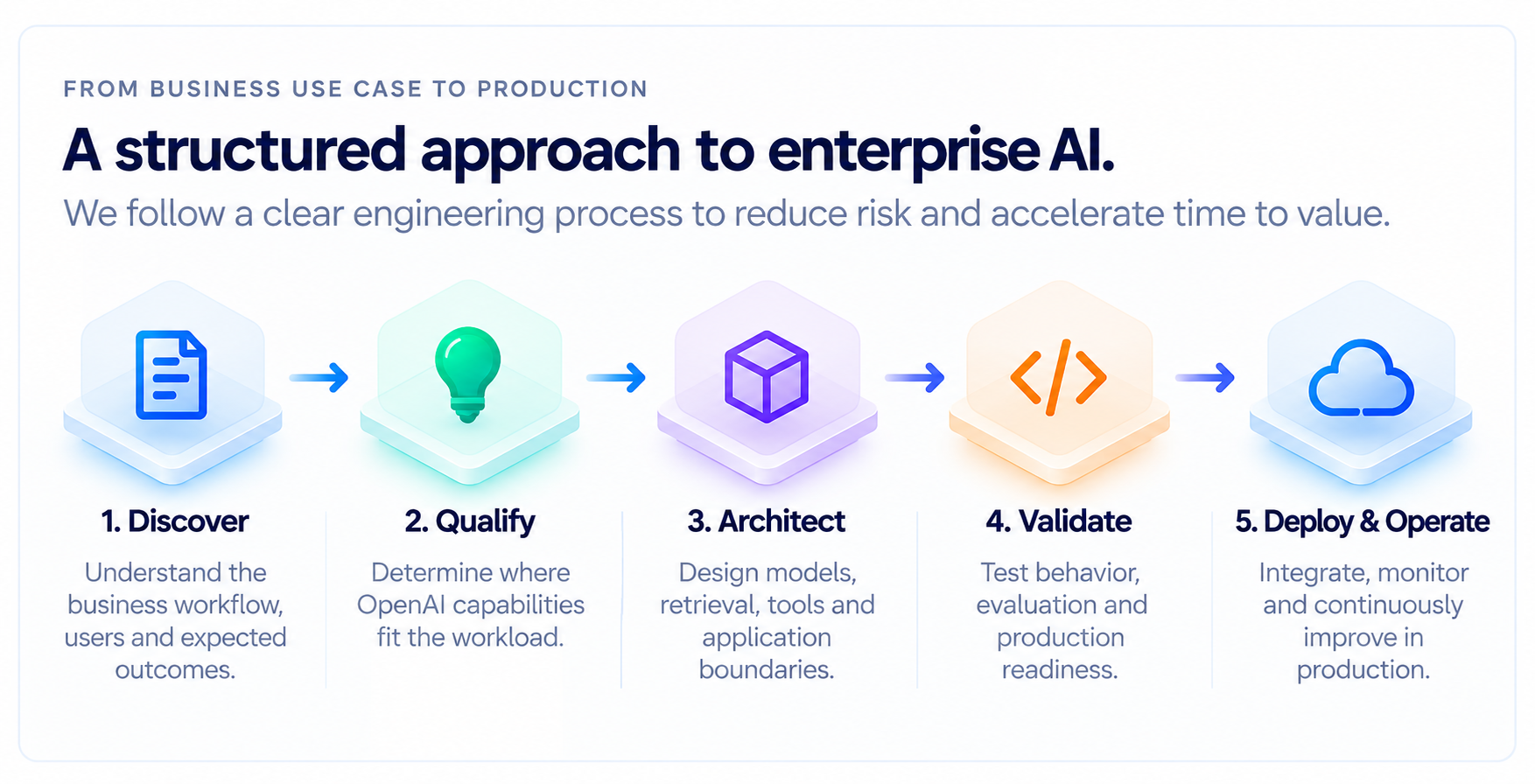
1. Discover the AI Use Case
A use case needs a measurable task, a clear user and a path to the data or systems it depends on. TitanBases works with the customer to distinguish a useful application workflow from a model demonstration and to identify constraints early.
- Define the user, workflow and decision or output the AI application will support.
- Identify required enterprise data, systems, permissions and human review points.
- Set evaluation criteria for usefulness, quality, latency and operational fit.
- Prioritize a bounded first implementation with a clear path to broader deployment.
2. Design the OpenAI Solution Architecture
TitanBases designs the application around the workload rather than treating a model API call as the whole system. The architecture connects OpenAI models and APIs with application logic, enterprise context, retrieval, tools, identity and operating controls. Model and pattern choices should be tested against the customer’s requirements.
- Model and API integration — select interactions, outputs and orchestration patterns appropriate to the task.
- Enterprise context — identify source data, freshness, ownership and retrieval requirements.
- Application and tools — connect APIs and business systems through controlled workflows.
- Security and operations — define authentication, authorization, logging, evaluation and deployment boundaries.
3. Prototype and Validate Solution Patterns
Before production, TitanBases can prototype the workflow and validate whether the proposed solution pattern is suitable. A useful prototype tests more than a single successful prompt: it exercises representative data, retrieval, tool behavior, failure handling and evaluation criteria.
- Build a bounded workflow around a specific user task.
- Test model responses with representative inputs and expected outcomes.
- Validate retrieval, tool calls, permissions and failure paths.
- Record findings and decide what needs to change before production.
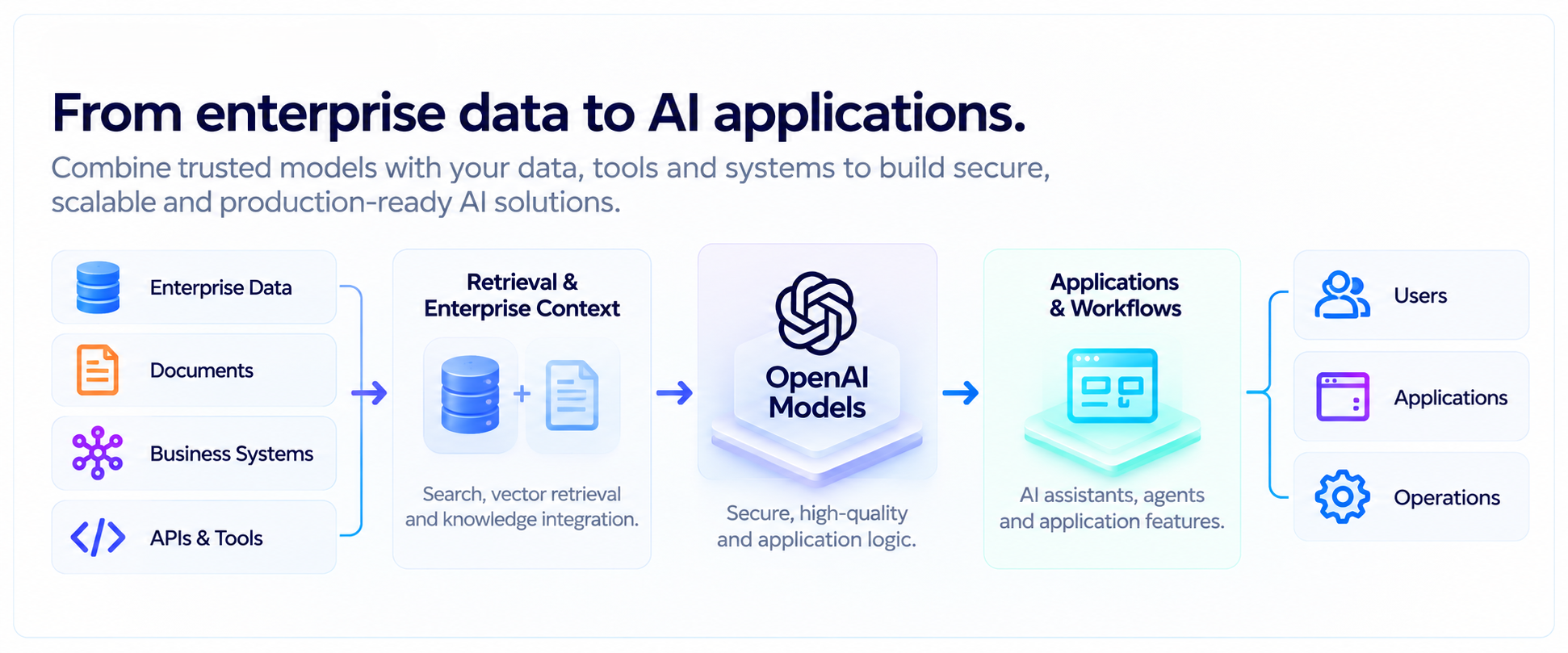
4. Connect Retrieval, Tools and Enterprise Applications
Enterprise AI often needs current organizational context and a controlled way to act within existing systems. TitanBases can design retrieval over documents and operational data, integrate model workflows with APIs and tools, and keep authorization in the application layer. Retrieval quality, source traceability and permitted actions need to be evaluated for each workload.
- Retrieval — source selection, indexing, filtering, ranking and context assembly.
- Data permissions — ensure the requesting user or workflow can access each source.
- Tools and APIs — define allowed actions, validation and approval checkpoints.
- Application integration — connect the AI workflow with existing interfaces and business processes.
5. Evaluate Quality, Guardrails and Security
Moving toward production requires evidence that the complete workflow behaves acceptably under realistic conditions. TitanBases can help define evaluations for task quality and retrieval, test adverse or ambiguous inputs, and implement guardrails alongside authentication, authorization and data handling controls. Human review and escalation remain important where the workflow calls for them.
- Evaluation sets and acceptance criteria for the intended task.
- Tests for retrieval relevance, output quality and failure cases.
- Guardrails for inputs, outputs and tool execution.
- Authentication, access controls and data boundaries.
- Tracing and review processes for errors and unexpected behavior.
6. Prepare for Enterprise Deployment
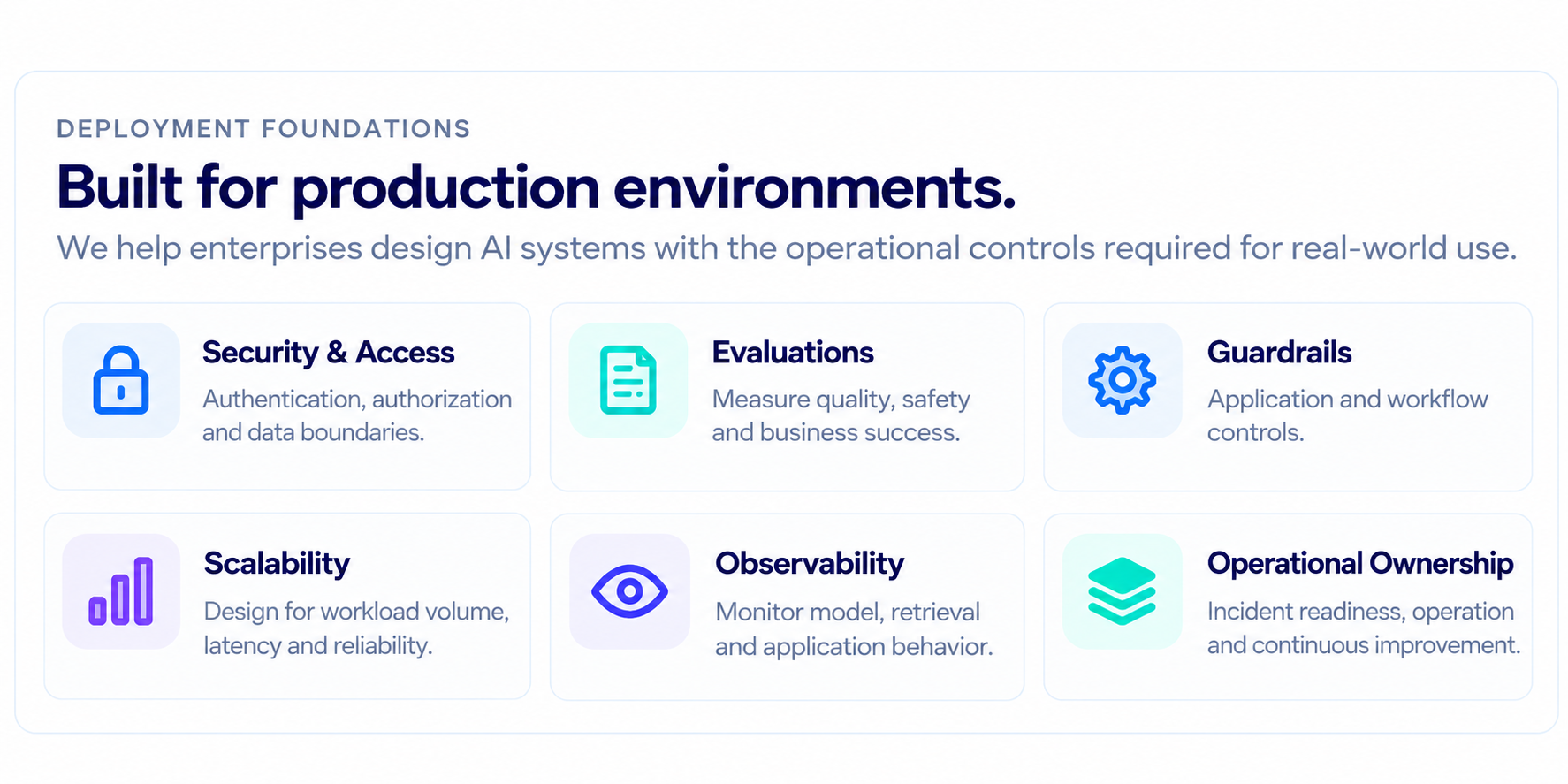
Deployment planning turns a validated pattern into an operating system. TitanBases can help define the target environment, integration boundaries, scaling behavior, release process, monitoring and incident response. Production readiness should be assessed against the customer’s security, resilience, latency and governance requirements.
- Confirm architecture, ownership and environment boundaries.
- Test capacity, latency, reliability and recovery behavior.
- Establish deployment, rollback and change controls.
- Instrument logs, traces, metrics and quality monitoring.
- Define operating responsibilities and a plan for ongoing evaluation.
Coordinated Engagement with OpenAI
For an appropriate opportunity, and where the customer chooses, TitanBases can coordinate with OpenAI through the Partner Network while acting as the solution and deployment engineering partner. The form of engagement depends on the use case and the participants involved; it does not imply a guaranteed OpenAI sales or technical resource. TitanBases remains responsible for its own assessment, architecture and delivery work.
How This Fits the TitanBases Engineering Stack
AI & Automation connects the model to enterprise workflows. Data Platforms provides governed context, search and retrieval. Cloud & Infrastructure supports the runtime and environment foundations. Platform Engineering addresses delivery pipelines, observability and production operations. Together, these disciplines help turn a validated use case into a deployable application.
Technical Evidence: From PoC to Production
For a deeper engineering view, read From AI PoC to Production: An Enterprise Architecture for OpenAI Applications. It explains the application layers connecting users, OpenAI models, enterprise retrieval, tools, security, evaluation and operations.
Exploring an enterprise OpenAI use case? TitanBases can help assess the workload, design the architecture and define a path from initial validation to production deployment.
Explore AI & Automation