Scaling OpenAI APIs in Production: Rate Limits, Queues, Caching and Cost Controls
A production engineering guide to OpenAI API rate limits, retries, queues, prompt caching, batching, latency, observability and cost controls.
Published Oct 3, 2026 · Updated Oct 3, 2026
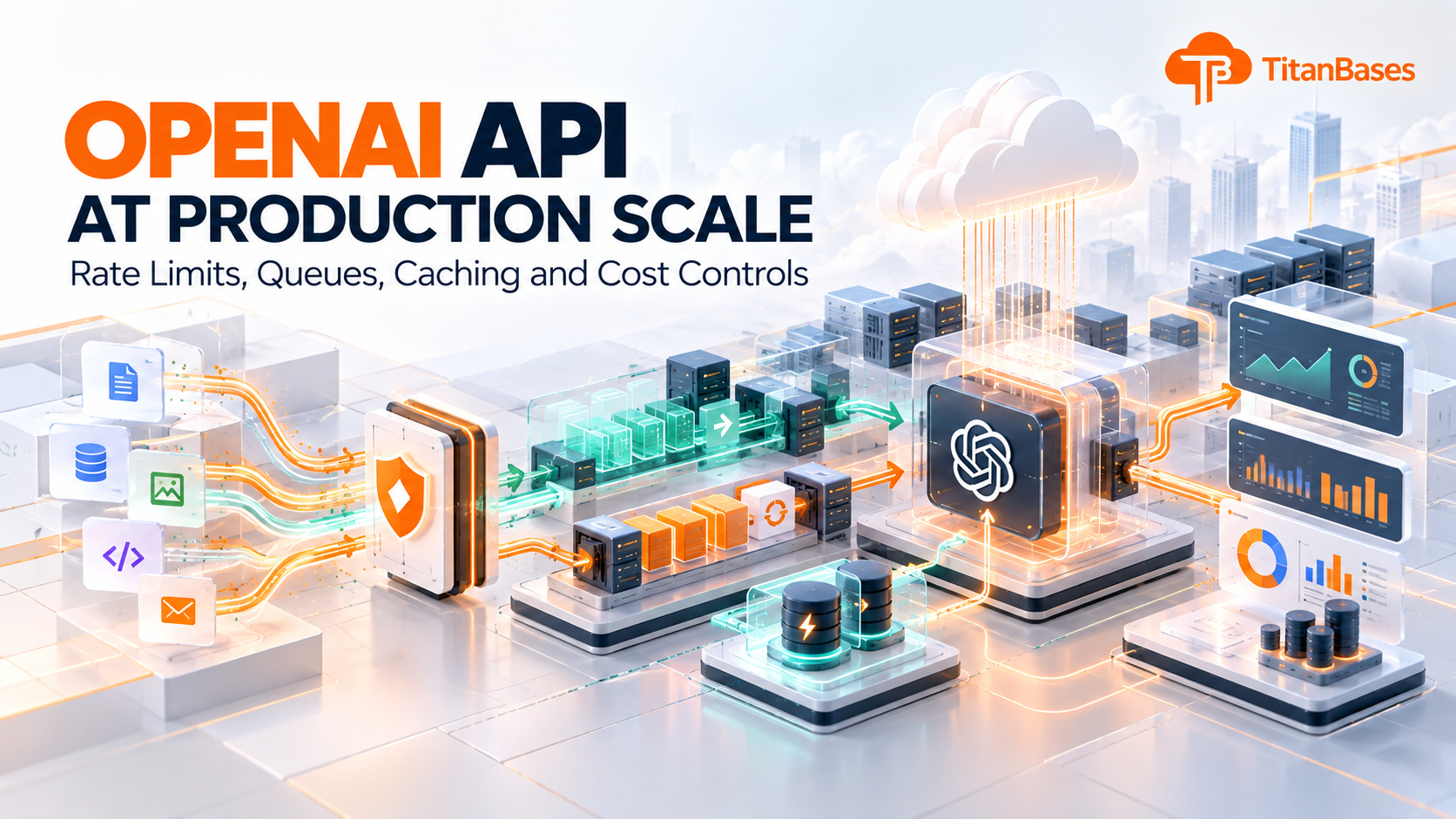
Scaling an OpenAI API workload is not mainly a question of sending more requests. Production systems need to control how traffic enters the application, how requests consume token and request budgets, what happens when capacity is temporarily unavailable, which work can be deferred, and how cost and latency are measured per workflow. Retries are only one layer. A resilient design combines rate-limit awareness, bounded retries, queueing or admission control, prompt and request optimization, asynchronous processing where appropriate, and observability around usage, errors and spend.
OpenAI exposes rate-limit information at the API boundary, while the application remains responsible for deciding how to shape traffic and protect downstream workflows. For enterprises using OpenAI in production, the engineering objective is therefore not to eliminate every 429. It is to make overload predictable, bounded and observable so the rest of the system remains controlled.
Start with the limits the application is actually consuming
OpenAI rate limits are not a single requests-per-second number. Limits can vary by model and can apply at organization or project scope. Responses can expose headers describing request limits, token limits, remaining capacity and reset timing. Production clients should capture these signals because they are more useful than treating every 429 as an identical failure.
At minimum, the runtime should distinguish temporary rate limiting from quota, billing, authentication and application errors. A temporary 429 may be retryable. An exhausted quota, invalid credential or billing condition requires a different operational path. Collapsing all of these cases into a generic retry loop increases noise and can make an incident worse.
Retries are recovery - not traffic control
When the API returns a temporary rate-limit response, OpenAI recommends respecting Retry-After when it is provided. If a server hint is unavailable, bounded exponential backoff with jitter is the standard recovery pattern. The retry budget should cap both attempts and total elapsed time so a degraded dependency cannot hold application resources indefinitely.
Retries do not create additional capacity. OpenAI notes that unsuccessful requests still contribute to per-minute limits. A client that immediately resends failed requests can therefore amplify pressure instead of relieving it. This is why retries should sit behind a broader traffic-management strategy rather than becoming the strategy themselves.
When a queue is better than another retry
Queueing is an application architecture decision, not an OpenAI API requirement. It becomes useful when incoming work can arrive faster than the application should send it downstream, or when work does not need to complete in the same request-response cycle. A queue creates a buffer between user demand and model demand so the application can control concurrency, preserve priority and avoid a retry storm.
A practical production pattern is: Ingress → authentication and policy → workload classification → admission control → synchronous path or queue → concurrency/rate controller → OpenAI API → validation → result store or caller
Interactive requests may stay on a synchronous path with a strict latency budget. Background enrichment, document processing, evaluation runs and bulk generation can move to queues or asynchronous APIs. The important design choice is to separate work by service-level expectation rather than force all requests through the same path.
Shape traffic before it reaches the model
Traffic shaping protects both user experience and shared capacity. The application can control maximum in-flight requests, per-tenant concurrency, request priority, token budgets and burst behavior before calling OpenAI. A global limiter alone may allow one noisy tenant or workflow to consume the entire budget, so enterprise systems often need multiple scopes.
Reduce the work per request before adding more infrastructure
OpenAI's latency guidance emphasizes several levers that also reduce cost and capacity pressure: generate fewer tokens, use fewer input tokens, make fewer requests, parallelize independent work and avoid using an LLM when deterministic logic is sufficient. These are architecture decisions as much as prompt decisions.
For example, a workflow that performs four sequential model calls may have higher latency and consume more request capacity than a design that combines compatible steps, parallelizes independent steps or moves deterministic validation into application code. Optimization should begin by measuring the workflow graph, not by assuming the answer is a higher rate limit.
Use prompt caching for stable prefixes - but do not treat it as a rate-limit bypass
Prompt caching can reuse matching prompt prefixes on supported OpenAI models. This can reduce input-processing latency and lower the price of eligible cached input, especially when long instructions, tool definitions or reference context remain stable across requests. The benefit depends on how much of the prefix is actually reusable and on the current model's caching behavior and pricing.
Two operational details matter. First, prefix stability is essential: changing content before the reusable boundary can reduce cache reuse. Second, cached input tokens still count toward tokens-per-minute rate limits. Caching can improve latency and economics, but it should not be presented as additional rate-limit capacity. Measure cache performance using actual cached-token usage, latency and realized cost rather than assuming a theoretical cache-hit rate. A session or shared context does not guarantee a cache hit.
Move non-interactive work off the synchronous path
Not every AI workload needs an immediate response. OpenAI's Batch API is designed for asynchronous groups of requests and currently documents lower cost, a separate pool of higher rate-limit headroom and a completion window of up to 24 hours. This makes it relevant for workloads such as offline enrichment, evaluation runs, classification, summarization at scale or scheduled processing where user latency is not the primary requirement.
The architecture decision is therefore broader than 'API versus queue.' A background job may use an application queue, Batch API, or both. The correct choice depends on completion-time requirements, retry semantics, data workflow and how results are consumed. Current Batch pricing and limits should be verified before being included in a customer cost model.
Treat cost as an operational signal, not just a monthly invoice
Production AI cost control becomes more useful when usage is attributable. Tracking only one organization-wide spend number makes it difficult to explain which customer, feature or workflow is consuming tokens. The application should attach its own business dimensions to API telemetry so engineering and finance can answer where usage comes from. OpenAI also supports project-level controls that can help separate environments and constrain usage. Application-level budgets remain useful because infrastructure limits do not know the business value or priority of each request.
Observability for OpenAI production traffic
A production dashboard should make both dependency health and workload behavior visible. The exact metric names depend on the application, but the following signals form a useful baseline.
- Request rate and token rate by model, project, tenant and feature.
- 429 rate separated from quota, billing, authentication, timeout and 5xx errors.
- Retry count, retry latency and requests abandoned after retry budget exhaustion.
- Queue depth, oldest-message age, processing rate and dead-letter volume where queues are used.
- End-to-end latency plus model/API latency so application overhead is visible.
- Input, output, cached-input and cache-write token usage where supported.
- Cache-hit effectiveness measured from actual usage rather than an assumed percentage.
- Cost attribution by tenant, feature, workflow and successful business outcome.
- Circuit-breaker or degraded-mode activations.
Design a controlled failure path
Production design should define what happens when the preferred model path is unavailable or too slow. A controlled failure path may include delaying low-priority jobs, returning a user-visible retry state, switching to a less expensive or lower-capability route where the workload permits it, serving a deterministic fallback, or escalating to human review. The fallback must preserve business and safety boundaries; it should not silently change a high-risk workflow into a lower-quality decision path. Circuit breakers can prevent an unhealthy dependency from receiving more traffic while the application is already failing. Bulkheads can isolate workloads so one queue or feature does not exhaust all workers. These are general distributed-systems patterns applied around the OpenAI dependency; they are not substitutes for evaluation of AI behavior.
A practical production control loop
- Classify the workload - interactive, asynchronous, critical, background or batch.
- Define SLOs and budgets - latency, concurrency, token volume, cost and acceptable degradation.
- Capture API rate-limit and error signals - do not reduce every failure to “retry”.
- Add bounded retry behavior - respect Retry-After and use exponential backoff with jitter when appropriate.
- Introduce admission control or queues where bursts must be absorbed.
- Reduce requests and tokens - optimize the workflow before requesting more capacity.
- Use prompt caching for stable reusable prefixes and measure real cache performance.
- Move eligible offline work to asynchronous processing such as Batch.
- Attribute usage and cost to tenants, features and outcomes.
- Test degraded modes and operational runbooks before production traffic depends on them.
What this changes in an enterprise architecture
The OpenAI API should sit behind an application control plane rather than be called directly from every product surface. That control plane is where identity, policy, workload classification, rate awareness, retry budgets, queues, routing, telemetry and cost attribution can be enforced consistently.
This article complements TitanBases' broader OpenAI production architecture guidance. The PoC-to-Production article explains the surrounding enterprise system - data, retrieval, tools, security, evaluation and operations. This guide focuses specifically on how the API traffic layer behaves under scale.
Key takeaways
- A 429 is a capacity signal to manage, not a reason for an unbounded retry loop.
- Respect server retry hints and keep retry budgets bounded.
- Queues and admission control are useful when demand can exceed safe downstream concurrency.
- Prompt caching improves eligible input economics and latency, but cached tokens still count toward token rate limits.
- Reduce requests and tokens before assuming the solution is more capacity.
- Use asynchronous processing for workloads that do not need interactive latency.
- Track usage and cost by business dimension, not only at organization level.
- Production readiness includes a tested degraded mode and an operational owner.