Engineering Security & Resilience for AWS Workloads with TitanSentry
TitanSentry brings security, observability, incident readiness and recovery thinking into the engineering lifecycle for AWS workloads.
Published Sep 25, 2026 · Updated Sep 25, 2026
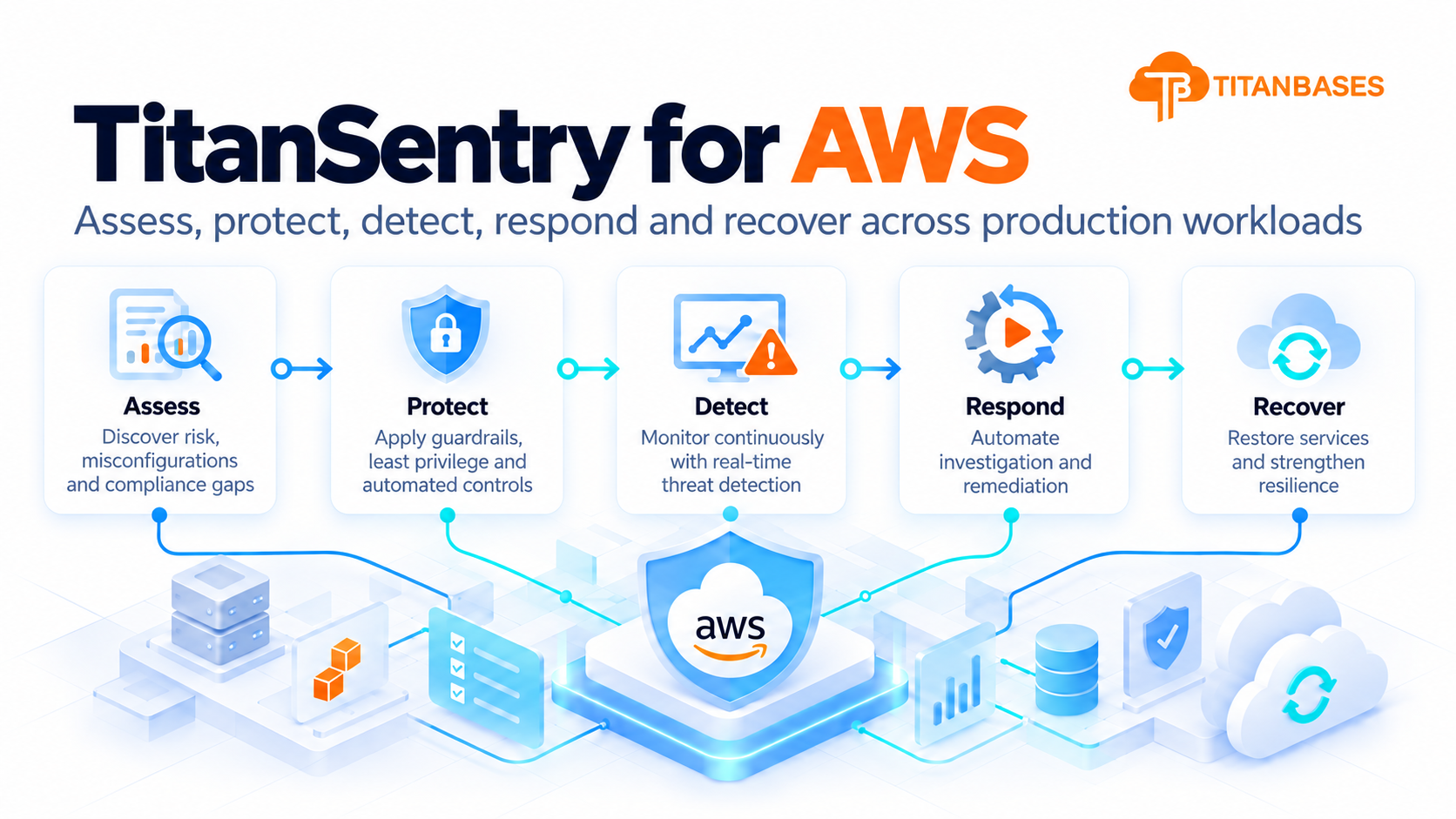
Production security is not a single control or product. AWS workloads operate across identity, networking, applications, data, observability, deployment pipelines and operational processes. Weakness in any of these areas can become an operational risk. TitanBases approaches security and resilience as part of the engineering lifecycle through TitanSentry: connecting architecture, visibility, incident readiness and recovery rather than treating security as a separate layer added after deployment.
Security Starts with Architecture
Security decisions are shaped by how the system is designed. Identity boundaries, network segmentation, workload exposure, data flows, administrative access and deployment patterns determine which controls are possible and where operational risk can accumulate. A production security model therefore needs to understand the architecture before selecting controls.
- Identity and access boundaries
- Network and workload exposure
- Data movement and access
- Secrets and privileged access
- Application dependencies
- Deployment pathways
- Logging and telemetry
- Recovery requirements
From Prevention to Operational Resilience
Preventive controls reduce risk, but production engineering must also assume that systems can fail, credentials can be misused, dependencies can become unavailable and operational mistakes can occur. Resilience expands the security conversation from prevention toward detection, response and recovery.
- Assess — understand workload architecture and risk boundaries.
- Protect — establish preventative controls around identity, infrastructure and data.
- Detect — create visibility into relevant system and security behavior.
- Respond — define how incidents are triaged, contained and communicated.
- Recover — restore services and validate the environment after disruption.
- Improve — convert incidents and findings into architecture and operational improvements.
Visibility Is an Engineering Requirement
Security teams and platform teams both depend on telemetry. Without sufficient logging, monitoring and system context, teams may know that something is wrong without understanding where it occurred, what changed or which workload is affected. The TitanSentry concept therefore treats observability as part of both reliability and security operations.
- Infrastructure telemetry
- Application logs
- Identity activity
- Network events
- Deployment changes
- Security findings
- Incident timelines
- Recovery status
Incident Readiness Before the Incident
Incident response should not begin by deciding who owns the incident. Production teams need defined responsibilities, escalation paths, evidence sources and recovery procedures before a high-pressure event occurs.
- Ownership and escalation
- Incident classification
- Communication paths
- Evidence and telemetry access
- Containment procedures
- Backup and recovery paths
- Post-incident review
- Architecture remediation
Recovery Is Part of Security
Security and resilience converge during recovery. Backups, failover mechanisms and recovery procedures only create value if they can restore the workload to a known and trusted operating state. Recovery planning should therefore consider both service continuity and confidence in the environment being restored.
- Backup integrity
- Recovery objectives
- Application dependencies
- Infrastructure restoration
- Data recovery
- Credential and secret rotation
- Validation after recovery
- Controlled return to service
Where TitanSentry Fits
TitanSentry is presented here as an engineering approach to connecting security and resilience across the lifecycle of AWS workloads. The scope begins with architecture assessment and considers protection, visibility, incident readiness, response, recovery and continuous improvement as connected design and operating questions. Specific service capabilities and delivery arrangements should be defined against the workload and the approved TitanSentry offering before an engagement.
TitanSentry and Platform Engineering
Security becomes easier to operate when it is integrated with the same engineering systems used to deploy and run applications. Platform Engineering can connect infrastructure standards, CI/CD, observability, operational controls and security practices into repeatable delivery paths. This reduces the distance between security requirements and day-to-day engineering operations.
- Infrastructure standards
- CI/CD and change controls
- Infrastructure as Code
- Observability foundations
- Security visibility
- Incident readiness
- Recovery automation
- Operational ownership
Related practices: Platform Engineering and Cloud & Infrastructure.
Security and Resilience as a Continuous Loop
Production systems evolve continuously. New application releases, infrastructure changes, dependencies and workloads can alter the security and resilience profile of the environment. The TitanSentry approach in this article is therefore an ongoing engineering model rather than a one-time assessment.
Assess → Protect → Observe → Detect → Respond → Recover → Improve
Key Takeaways
Building production workloads that need stronger security and resilience foundations? TitanBases connects cloud architecture, platform engineering, observability and operational readiness in the TitanSentry approach described here.
Explore Platform Engineering